
Othala — inheritance, ancestral holding, patrimony
sound o · Proto-Germanic *ōþila · rune 24 of 24 · also spelled Odal
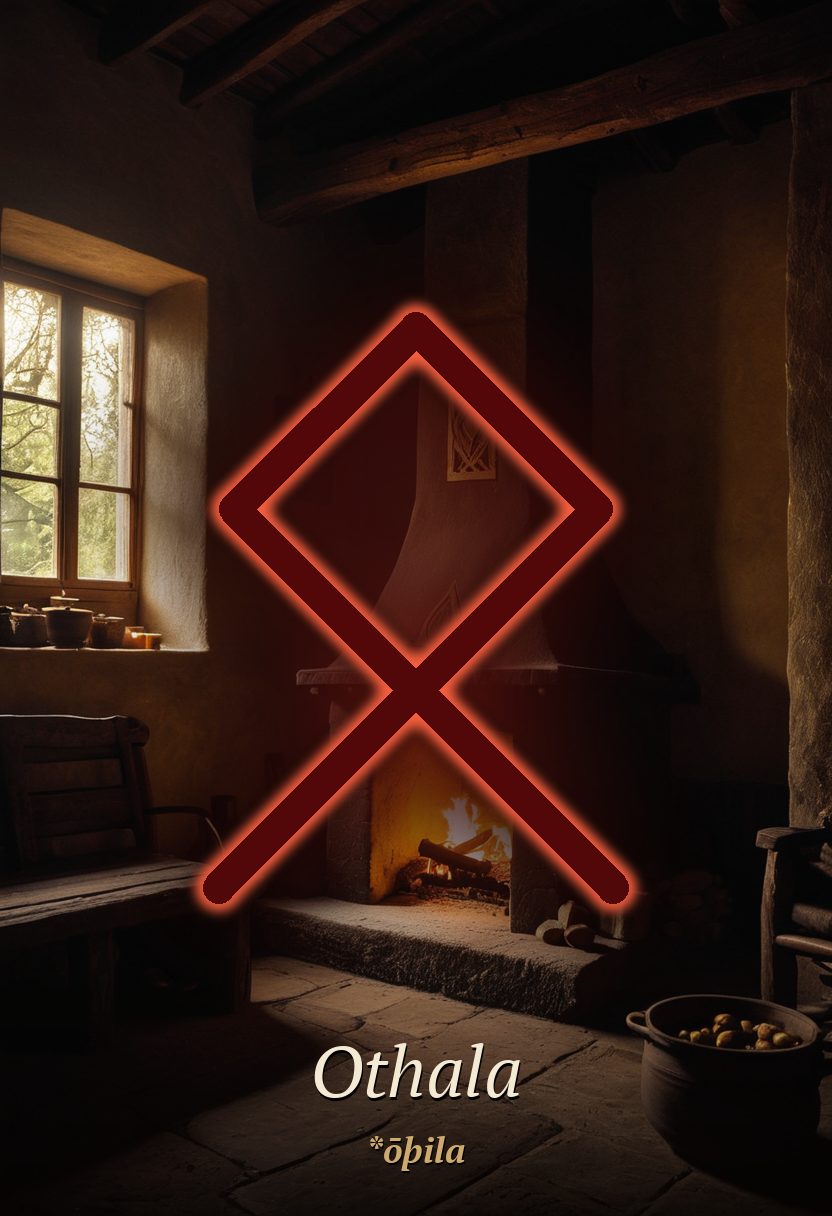
Claimed by the revival to be the mystery of the kindred's enclosure-stronghold, which marks out its sacred boundary and guards it against unclean intruders — said to be the essence of the cosmic notion of Midgard, the "enclosure in the middle." The O-rune is read as a sign of the innate qualities that come from descent from a particular kindred: spiritual in nature, traced back to a divine ancestor and to the past deeds of forebears. It is taken to be the mystery of the fylgja as a spiritual source of magical power, accumulating from the valiant deeds of past generations as runic imprints in the "genetic codes" of descendants (a mighty rune of Odin; its form is read as a monogram of Odin). What is inherited by the whole kindred in material and spiritual terms is held to be as immovable as land, not alienable from the kindred.
Core meaningmodern reconstruction, 20th c.
Claimed by the revival to be the mystery of the kindred's enclosure-stronghold, which marks out its sacred boundary and guards it against unclean intruders — said to be the essence of the cosmic notion of Midgard, the "enclosure in the middle." The O-rune is read as a sign of the innate qualities that come from descent from a particular kindred: spiritual in nature, traced back to a divine ancestor and to the past deeds of forebears. It is taken to be the mystery of the fylgja as a spiritual source of magical power, accumulating from the valiant deeds of past generations as runic imprints in the "genetic codes" of descendants (a mighty rune of Odin; its form is read as a monogram of Odin). What is inherited by the whole kindred in material and spiritual terms is held to be as immovable as land, not alienable from the kindred. It is framed as a rune of material wealth and of the wise, just stewardship of land by tradition and law. (As with this rune's modern folkish use, the framing of "descent" and "kindred" here carries an appropriation history worth flagging.)
Othala in divinationmodern reconstruction, 20th c.
Paxson: OTHALA — family (physical or spiritual) and one's place in the community; living conditions (home, housemates), ancestral property, land, inheritance, inherited traits, connection to the ancestral homeland, finding a group of one's own spirit. A rune of kinship and the "sacred enclosure."
Draw this rune in a spread → free reading for your questionOthala reversed (merkstave)modern reconstruction, 20th c.
Paxson directly names the "opposite, or perversion" of OTHALA: totalitarianism and slavery; here too the Nazi abuse of the rune in doctrines of "Folk" and "racial purity," the danger of exclusionary innangarth thinking against all that is foreign.
Othala in rune magicmodern reconstruction, 20th c.
- maintaining order among kin
- focusing on the shared interests of home and family
- shifting from ego-centricity to kin-centricity
- gathering numinous power and knowledge from past generations
- attaining wealth and prosperity
- galdr: "othala-othala-othala… ooooo… othul-othal-othil-othel-othol…"
- Paxson (practice): a house-wight rite (Innangarth) — by the hearth set a clean boulder (the dwelling of the tomte/nisse), surround it with flowers, set out a glass of milk/beer and a plate of cookies (without calling them aloud an "offering"), and speak a greeting for harmony in the home; in the morning burn the remains.
The historical layerhistorical fact
The reconstructed Proto-Germanic name *ōþila means “inheritance, ancestral holding, patrimony” — that much comes from the rune poems and comparative linguistics. The esoteric readings above are a 20th–21st-century reconstruction, not an attested ancient practice — see the Elder Futhark reference for what is actually historical.
Sources
Esoteric core and magical workings — Thorsson, "Futhark" (1984); divination/shadow/practice — Diana Paxson, "Taking Up the Runes" (2005). Both are 20th–21st-c. revival, not antiquity and not proof.
Questions about Othala
What does the Othala rune mean?
Othala (*ōþila) — inheritance, ancestral holding, patrimony. Claimed by the revival to be the mystery of the kindred's enclosure-stronghold, which marks out its sacred boundary and guards it against unclean intruders — said to be the essence of the cosmic notion of Midgard, the "enclosure in the middle." The O-rune is read as a sign of the innate qualities that come from descent from a particular kindred: spiritual in nature, traced back to a divine ancestor and to the past deeds of forebears. It is taken to be the mystery of the fylgja as a spiritual source of magical power, accumulating from the valiant deeds of past generations as runic imprints in the "genetic codes" of descendants (a mighty rune of Odin; its form is read as a monogram of Odin).
What does Othala reversed mean?
Paxson directly names the "opposite, or perversion" of OTHALA: totalitarianism and slavery; here too the Nazi abuse of the rune in doctrines of "Folk" and "racial purity," the danger of exclusionary innangarth thinking against all that is foreign.
How do you pronounce Othala?
The sound is “o”; the reconstructed Proto-Germanic name is *ōþila.