
Fehu — cattle, wealth, movable property
sound f · Proto-Germanic *fehu · rune 1 of 24
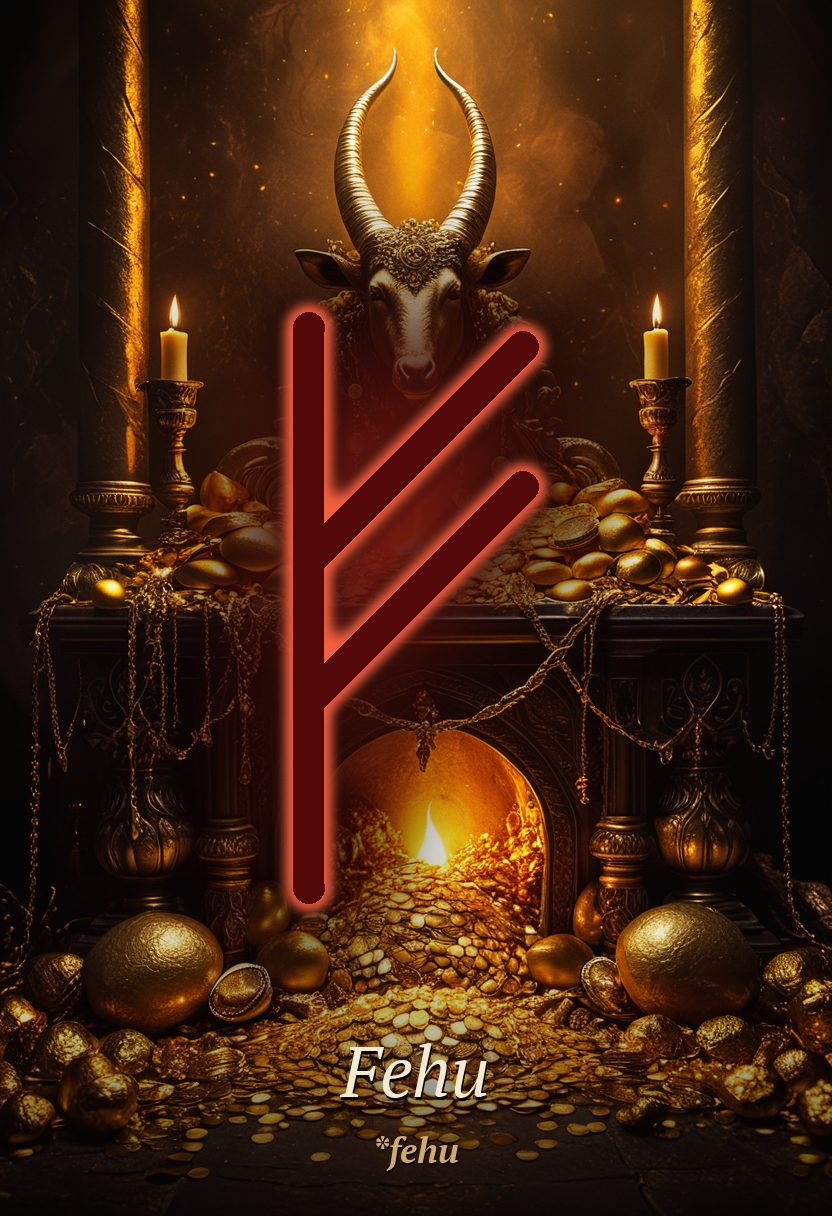
The raw archetypal energy of movement and expansion in the universe — the “fire of the cosmos” from Muspellsheim: the same force that creates the world and burns it up at Ragnarök (not the undifferentiated fire itself, but the mystery of its eternal working everywhere). It is the mobile form of force — from movable wealth (cattle → money → English fee) to the transfer of hamingja (one's “luck,” a guardian spirit) projected from person to person or onto an object (the “sending-rune”). It is the rune of eternal becoming (birth–life–death–rebirth); it governs the basic force of fertility.
Core meaningmodern reconstruction, 20th c.
The raw archetypal energy of movement and expansion in the universe — the “fire of the cosmos” from Muspellsheim: the same force that creates the world and burns it up at Ragnarök (not the undifferentiated fire itself, but the mystery of its eternal working everywhere). It is the mobile form of force — from movable wealth (cattle → money → English fee) to the transfer of hamingja (one's “luck,” a guardian spirit) projected from person to person or onto an object (the “sending-rune”). It is the rune of eternal becoming (birth–life–death–rebirth); it governs the basic force of fertility. In the myths it manifests as a glow around burial mounds or a ring of fire.
Fehu in divinationmodern reconstruction, 20th c.
Paxson: the rune of well-being and productivity — improvement in finances, health, or creative/physical fertility; ventures will flourish. On the whole a fortunate rune; appearing first in a spread, it promises success for whatever the neighboring runes signify.
Draw this rune in a spread → free reading for your questionFehu reversed (merkstave)modern reconstruction, 20th c.
Paxson does not single out a reversed meaning; among “warning runes” it counsels guarding one's physical/emotional resources, or else points to poverty and the inability to manage what one has. Wealth is a “mixed blessing” (the rune poems link it to strife among kin).
Fehu in rune magicmodern reconstruction, 20th c.
- strengthening of the psychic powers
- transfer and projection of force — the “sending-rune”
- drawing the power of the Sun, Moon, and stars into one's personal sphere
- advancing personal and social evolution, increasing prosperity
- galdr: “fehu-fehu-fehu… f-f-f-f-f…”
- Paxson (practice): inscribe Fehu in gold ink on your checkbook; in rites combine Fehu with Gebo — wealth “works” only by remaining in motion.
The historical layerhistorical fact
The reconstructed Proto-Germanic name *fehu means “cattle, wealth, movable property” — that much comes from the rune poems and comparative linguistics. The esoteric readings above are a 20th–21st-century reconstruction, not an attested ancient practice — see the Elder Futhark reference for what is actually historical.
Sources
Esoteric core and magical workings — Thorsson, Futhark (1984); divination/shadow/practice — Diana Paxson, Taking Up the Runes (2005). Both are 20th–21st-century revival, not antiquity and not proof.
Questions about Fehu
What does the Fehu rune mean?
Fehu (*fehu) — cattle, wealth, movable property. The raw archetypal energy of movement and expansion in the universe — the “fire of the cosmos” from Muspellsheim: the same force that creates the world and burns it up at Ragnarök (not the undifferentiated fire itself, but the mystery of its eternal working everywhere). It is the mobile form of force — from movable wealth (cattle → money → English fee) to the transfer of hamingja (one's “luck,” a guardian spirit) projected from person to person or onto an object (the “sending-rune”).
What does Fehu reversed mean?
Paxson does not single out a reversed meaning; among “warning runes” it counsels guarding one's physical/emotional resources, or else points to poverty and the inability to manage what one has. Wealth is a “mixed blessing” (the rune poems link it to strife among kin).
How do you pronounce Fehu?
The sound is “f”; the reconstructed Proto-Germanic name is *fehu.