
Dagaz — day
sound d · Proto-Germanic *dagaz · rune 23 of 24
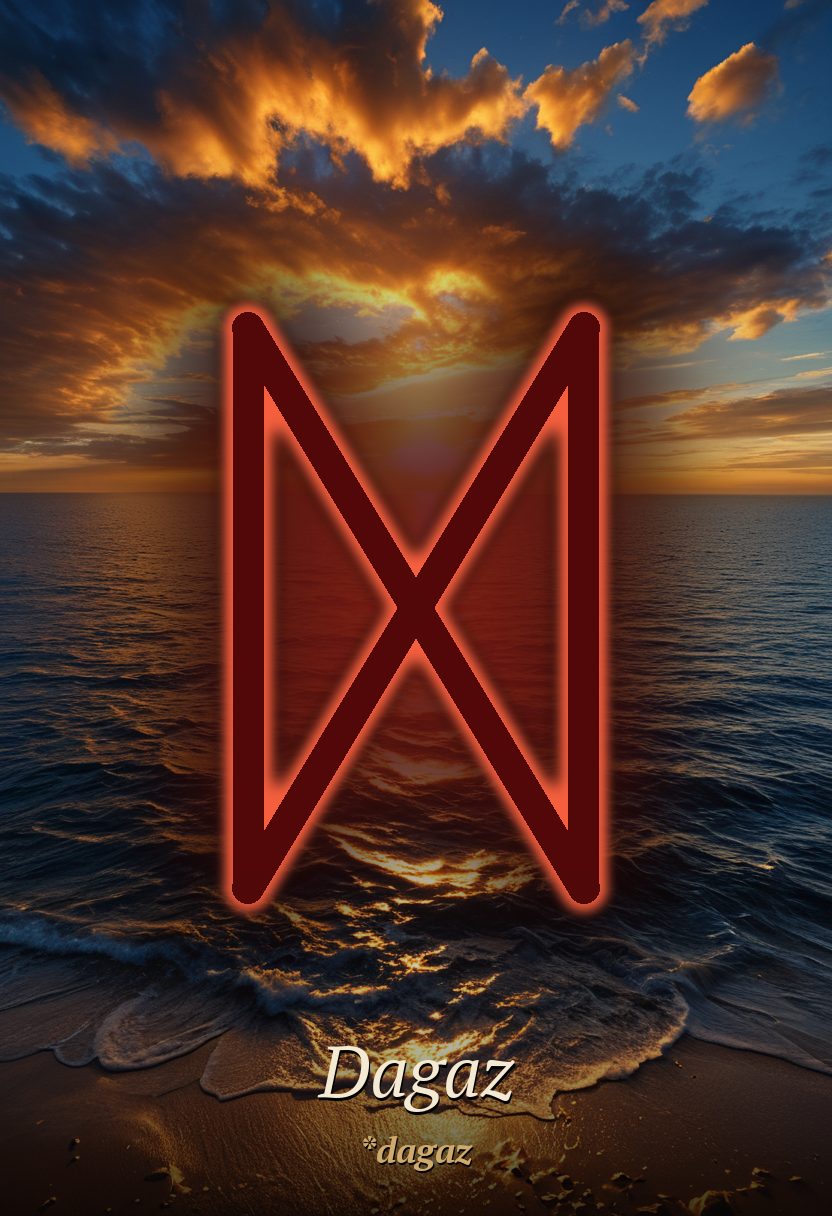
The light of day, perceived in the moments of sunrise and sunset, dawn and dusk — claimed by the revival to be the rune of full awakening (its mystery is read in the praise-prayer of Sigrdrífa, awakened by Sigurd). The D-rune is taken to be the ritual hearth-fire and the mystical light seen by the vitki in magical operations. Dagaz is framed as a synthesis of the powers of day and night through dawn and dusk, a rune of polarity and the "paradox of Odin," said to be the central mystery of the Odinic cult.
Core meaningmodern reconstruction, 20th c.
The light of day, perceived in the moments of sunrise and sunset, dawn and dusk — claimed by the revival to be the rune of full awakening (its mystery is read in the praise-prayer of Sigrdrífa, awakened by Sigurd). The D-rune is taken to be the ritual hearth-fire and the mystical light seen by the vitki in magical operations. Dagaz is framed as a synthesis of the powers of day and night through dawn and dusk, a rune of polarity and the "paradox of Odin," said to be the central mystery of the Odinic cult. It is held to be that "mystical moment" found in the whirl of polar concepts: through a secret "alchemy" two extremes become one — dark and light, pleasure and pain, life and death, body and soul, matter and energy are synthesized beyond their apparent opposition. Before dagaz, language is said to fail.
Dagaz in divinationmodern reconstruction, 20th c.
Paxson: DAGAZ — an almost entirely positive rune: good is coming, the "light at the end of the tunnel," the arrival of spring. Growth and increase in any sphere (often slow progress with a dramatic outcome), a turning point, dawn/sunset, awakening, hope. The counsel — to set oneself optimistically and persevere.
Draw this rune in a spread → free reading for your questionDagaz reversed (merkstave)modern reconstruction, 20th c.
The rune is symmetrical (a "butterfly"/infinity sign), so there is no reversal; the shadow comes from its liminality (Aswynn): a cataclysmic reversal, when energy, having reached saturation, flips into its opposite; the risk of self-deception in "spiritual awakening."
Dagaz in rune magicmodern reconstruction, 20th c.
- reaching the mystical moment through the secret of the Odinic paradox
- receiving mystical inspiration — the gift of Odin
- synthesis of polarities into a single transcendent "third" concept
- turning to the ritual hearth-fire and the mystical light
- galdr: "dagaz-dagaz-dagaz… dh-dh-dh-dh… daaaaagaaaazzz…"
- Paxson (practice): a dawn/Ostara ritual — before sunrise wash, put on clean clothes, go out to a view of the sunrise; with crossed arms (the DAGAZ stance) greet the Sun; throw a list of what has darkened your life into the fire, visualizing the light growing.
The historical layerhistorical fact
The reconstructed Proto-Germanic name *dagaz means “day” — that much comes from the rune poems and comparative linguistics. The esoteric readings above are a 20th–21st-century reconstruction, not an attested ancient practice — see the Elder Futhark reference for what is actually historical.
Sources
Esoteric core and magical workings — Thorsson, "Futhark" (1984); divination/shadow/practice — Diana Paxson, "Taking Up the Runes" (2005). Both are 20th–21st-c. revival, not antiquity and not proof.
Questions about Dagaz
What does the Dagaz rune mean?
Dagaz (*dagaz) — day. The light of day, perceived in the moments of sunrise and sunset, dawn and dusk — claimed by the revival to be the rune of full awakening (its mystery is read in the praise-prayer of Sigrdrífa, awakened by Sigurd). The D-rune is taken to be the ritual hearth-fire and the mystical light seen by the vitki in magical operations.
What does Dagaz reversed mean?
The rune is symmetrical (a "butterfly"/infinity sign), so there is no reversal; the shadow comes from its liminality (Aswynn): a cataclysmic reversal, when energy, having reached saturation, flips into its opposite; the risk of self-deception in "spiritual awakening."
How do you pronounce Dagaz?
The sound is “d”; the reconstructed Proto-Germanic name is *dagaz.