
Laguz — water, moisture, lake
sound l · Proto-Germanic *laguz · rune 21 of 24
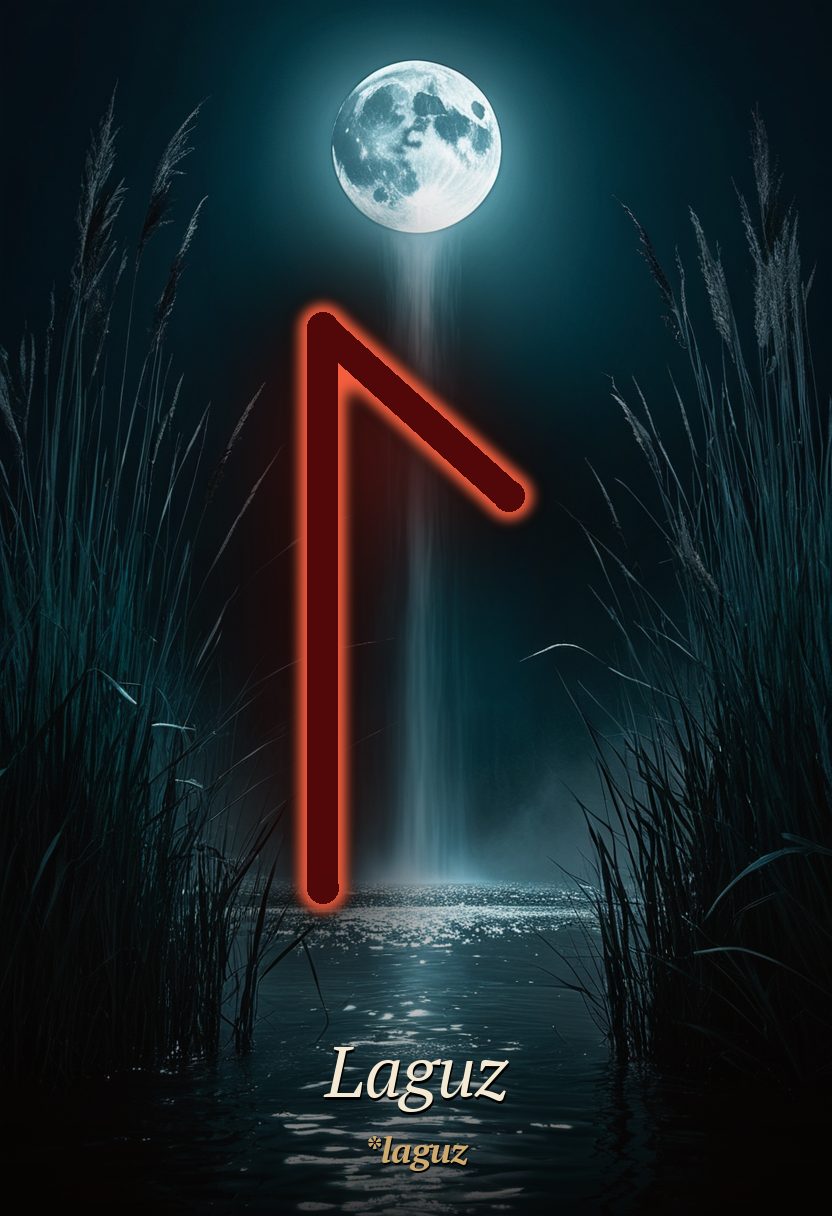
Held to be the basic life-energy of the multiverse and the secret source of all organic life; also the "law" (ON log) of life — the layers of past cosmic and human action governing the future development of forms, as the revival reads it. The L-rune is claimed to be the primal waters of Niflheim, holding the latent, formless potential of life that must be hardened by ice and kindled by the fire of Muspellsheim to be embodied. It is framed as a potent rune of initiation — especially initiation into life (the rite of sprinkling with water, vatni ausa, and the doctrine of rebirth).
Core meaningmodern reconstruction, 20th c.
Held to be the basic life-energy of the multiverse and the secret source of all organic life; also the "law" (ON log) of life — the layers of past cosmic and human action governing the future development of forms, as the revival reads it. The L-rune is claimed to be the primal waters of Niflheim, holding the latent, formless potential of life that must be hardened by ice and kindled by the fire of Muspellsheim to be embodied. It is framed as a potent rune of initiation — especially initiation into life (the rite of sprinkling with water, vatni ausa, and the doctrine of rebirth). Laguz is also said to govern the passage out of life (the crossing of the primal waters to the world of the dead). In the form laukaz ("leek") it is taken as a symbol of organic growth, phallic power, fertility, and herbal magic.
Laguz in divinationmodern reconstruction, 20th c.
Paxson: LAGUZ — a woman or feminine influence, new life and creative power rising from the depths of the unconscious, or a need to become more flexible and move with the currents of life. Often — transitions, contact with the psychic/astral, the powers of conception and birth, a promise of sympathetic help — to "go with the flow."
Draw this rune in a spread → free reading for your questionLaguz reversed (merkstave)modern reconstruction, 20th c.
Paxson gives no classic reversal; the shadow is water's ambivalence: an uncontrollable, unpredictable, dangerous element (in the Anglo-Saxon poem the sea is terrifying), stagnant and poisonous as against living running water.
Laguz in rune magicmodern reconstruction, 20th c.
- carrying one through the hard trials of initiation
- growth of life-force and vitality
- gathering amorphous magical power to be shaped by will
- strengthening "magnetism"
- developing the "second sight"
- galdr: "laguz-laguz-laguz… llllllll…"
- Paxson (practice): the "Healing Bath" — the bathroom as a temple of waters: consecrate the water by tracing LAGUZ over it, add sea salt; by candlelight lie back and visualize stress, pain, and illness dissolving while the body is re-formed in the life-giving embrace of the waters.
The historical layerhistorical fact
The reconstructed Proto-Germanic name *laguz means “water, moisture, lake” — that much comes from the rune poems and comparative linguistics. The esoteric readings above are a 20th–21st-century reconstruction, not an attested ancient practice — see the Elder Futhark reference for what is actually historical.
Sources
Esoteric core and magical workings — Thorsson, "Futhark" (1984); divination/shadow/practice — Diana Paxson, "Taking Up the Runes" (2005). Both are 20th–21st-c. revival, not antiquity and not proof.
Questions about Laguz
What does the Laguz rune mean?
Laguz (*laguz) — water, moisture, lake. Held to be the basic life-energy of the multiverse and the secret source of all organic life; also the "law" (ON log) of life — the layers of past cosmic and human action governing the future development of forms, as the revival reads it. The L-rune is claimed to be the primal waters of Niflheim, holding the latent, formless potential of life that must be hardened by ice and kindled by the fire of Muspellsheim to be embodied.
What does Laguz reversed mean?
Paxson gives no classic reversal; the shadow is water's ambivalence: an uncontrollable, unpredictable, dangerous element (in the Anglo-Saxon poem the sea is terrifying), stagnant and poisonous as against living running water.
How do you pronounce Laguz?
The sound is “l”; the reconstructed Proto-Germanic name is *laguz.