
Ingwaz — god/hero Ing / Ingwiz
sound ŋ · Proto-Germanic *ingwaz · rune 22 of 24 · also spelled Ing
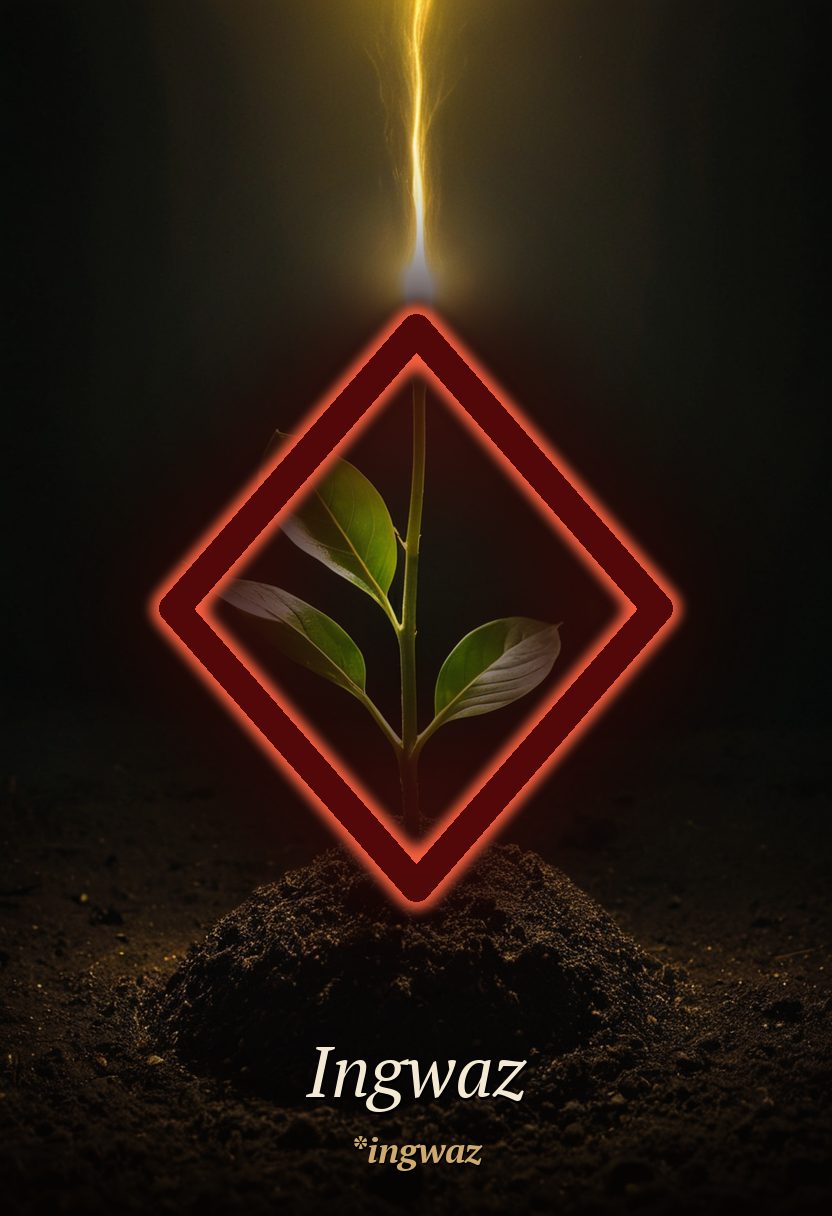
The name of the ancient Germanic earth-god Ing, who — as the revival reads it — acts in a pair with the mother-goddess Nerthus (the peoples called themselves Ingaevones — "those of Ing"; later Freyr became Ing-Yngvi). In the cult of Ing-Nerthus the feminine is said to absorb the masculine so as to replenish its forces after giving fertility to the earth: the masculine is framed as a self-replenishing "cosmic food" of potential energy, held by the goddess through the winter and released in a rush in spring. The NG-rune is taken as a storehouse of potential energy that must pass through a period of ripening (gestation) to gather strength: any force, before its most powerful manifestation, is said to pass through such a sheltered ripening.
Core meaningmodern reconstruction, 20th c.
The name of the ancient Germanic earth-god Ing, who — as the revival reads it — acts in a pair with the mother-goddess Nerthus (the peoples called themselves Ingaevones — "those of Ing"; later Freyr became Ing-Yngvi). In the cult of Ing-Nerthus the feminine is said to absorb the masculine so as to replenish its forces after giving fertility to the earth: the masculine is framed as a self-replenishing "cosmic food" of potential energy, held by the goddess through the winter and released in a rush in spring. The NG-rune is taken as a storehouse of potential energy that must pass through a period of ripening (gestation) to gather strength: any force, before its most powerful manifestation, is said to pass through such a sheltered ripening. The rune is held to contain one of the great mysteries of Norse sex-magic.
Ingwaz in divinationmodern reconstruction, 20th c.
Paxson: INGWAZ — creative power (especially male), the passage to a new stage of the cycle, a completion leading to a new beginning, transformation, possibly sacrifice for a positive goal, fertility. Often — the successful completion of a project; kin to Fehu and Jera; a rune of sexuality and male energy when the force "gives" rather than only "takes."
Draw this rune in a spread → free reading for your questionIngwaz reversed (merkstave)modern reconstruction, 20th c.
The rune is symmetrical (a closed diamond), so there is no reversal; the shadow arises from the rune's nature: the sacrificial god gives his power to the earth and goes down into death/the barrow — the energy must pass through a hidden gestation, a potential that is "dormant"; the masculine and feminine must interact as equals, or the force is not realized.
Ingwaz in rune magicmodern reconstruction, 20th c.
- storing and transforming power for ritual use
- rites of fertility
- passive meditation and the centering of energy and thought
- sudden release of energy
- galdr: "ingwaz-ingwaz-ingwaz… iiiiinnnnnggggg…"
- Paxson (practice): meditation on INGWAZ as a key to the "male mysteries" — mentally pass through the cycle of the grain-god: emergence from the sea, radiant youth, the Sacred Marriage, the begetting and protection of offspring, beneficent rule, death-transformation into an ancestor.
The historical layerhistorical fact
The reconstructed Proto-Germanic name *ingwaz means “god/hero Ing / Ingwiz” — that much comes from the rune poems and comparative linguistics. The esoteric readings above are a 20th–21st-century reconstruction, not an attested ancient practice — see the Elder Futhark reference for what is actually historical.
Sources
Esoteric core and magical workings — Thorsson, "Futhark" (1984); divination/shadow/practice — Diana Paxson, "Taking Up the Runes" (2005). Both are 20th–21st-c. revival, not antiquity and not proof.
Questions about Ingwaz
What does the Ingwaz rune mean?
Ingwaz (*ingwaz) — god/hero Ing / Ingwiz. The name of the ancient Germanic earth-god Ing, who — as the revival reads it — acts in a pair with the mother-goddess Nerthus (the peoples called themselves Ingaevones — "those of Ing"; later Freyr became Ing-Yngvi). In the cult of Ing-Nerthus the feminine is said to absorb the masculine so as to replenish its forces after giving fertility to the earth: the masculine is framed as a self-replenishing "cosmic food" of potential energy, held by the goddess through the winter and released in a rush in spring.
What does Ingwaz reversed mean?
The rune is symmetrical (a closed diamond), so there is no reversal; the shadow arises from the rune's nature: the sacrificial god gives his power to the earth and goes down into death/the barrow — the energy must pass through a hidden gestation, a potential that is "dormant"; the masculine and feminine must interact as equals, or the force is not realized.
How do you pronounce Ingwaz?
The sound is “ŋ”; the reconstructed Proto-Germanic name is *ingwaz.