The raw archetypal energy of movement and expansion in the universe — the “fire of the cosmos” from Muspellsheim: the same force that creates the world and burns it up at Ragnarök (not the undifferentiated fire itself, but the mystery of its eternal working everywhere). It is the mobile form of force — from movable wealth (cattle → money → English fee) to the transfer of hamingja (one's “luck,” a guardian spirit) projected from person to person or onto an object (the “sending-rune”). It is the rune of eternal becoming (birth–life–death–rebirth); it governs the basic force of fertility. In the myths it manifests as a glow around burial mounds or a ring of fire.
Divination. Paxson: the rune of well-being and productivity — improvement in finances, health, or creative/physical fertility; ventures will flourish. On the whole a fortunate rune; appearing first in a spread, it promises success for whatever the neighboring runes signify.
Paxson does not single out a reversed meaning; among “warning runes” it counsels guarding one's physical/emotional resources, or else points to poverty and the inability to manage what one has. Wealth is a “mixed blessing” (the rune poems link it to strife among kin).
Weave this rune into a bind rune →
Historical meaning of the name: cattle, wealth, movable property.
The esoteric layer is a 20th–21st-c. reconstruction (Edred Thorsson = Stephen Flowers et al.). Not ancient and not proven magic; the rune names are not recorded in the inscriptions themselves. “Reversed” (merkstave) meanings are a late divinatory convention (popularized by R. Blum, 1982, after the Tarot model); symmetrical runes have no reversed form.
Sources: Esoteric core and magical workings — Thorsson, Futhark (1984); divination/shadow/practice — Diana Paxson, Taking Up the Runes (2005). Both are 20th–21st-century revival, not antiquity and not proof.

The mother-rune of manifestation: the shaping, ordering force that sets the pattern of matter and ultimately builds the world. In mythology it is the great cow Audhumla, herself born from rime at the meeting of the world-fire and the world-ice: she licked the first ancestor Buri out of the salt and nourished the giant Ymir. It is the cosmic seed, the undivided prototype of all things, the form-giving force (but not form itself), the eternal reservoir of archetypal patterns. Because it holds the pattern of the natural order, it is a rune of wisdom and lore, and in the personal sphere a rune of robust health, vital strength, and masculine power.
Divination. Paxson: the rune of manifestation and primal force — physical resources become available, spiritual energy yields results; it speaks of health and vitality, of the need to act, take risks, and change in order to gain or protect resources. It helps other runes manifest on the physical plane.
Paxson: in a “negative position” — difficulty with change, or the need to let go of the past; like a melting glacier, a hint to watch where one's energy is headed.
Weave this rune into a bind rune →
Historical meaning of the name: aurochs, wild ox.
The esoteric layer is a 20th–21st-c. reconstruction (Edred Thorsson = Stephen Flowers et al.). Not ancient and not proven magic; the rune names are not recorded in the inscriptions themselves. “Reversed” (merkstave) meanings are a late divinatory convention (popularized by R. Blum, 1982, after the Tarot model); symmetrical runes have no reversed form.
Sources: Esoteric core and magical workings — Thorsson, Futhark (1984); divination/shadow/practice — Diana Paxson, Taking Up the Runes (2005). Both are 20th–21st-century revival, not antiquity and not proof.

The directed cosmic force of destruction and protection — an archetypal, instinctual will without self-awareness. It is lightning and thunder, identified with Mjöllnir, Thor's hammer: the weapon that crushes the etins and guards the enclosures of Midgard and Asgard against forces hostile to the cosmic order. As the thorn protects the rose, so the hammer protects the world of the gods. It is also a projected, applied force that directs energy, and a rune of regeneration and fertilization: as lightning heralds life-giving rains, so the thorn-awakening cuts through obstacles and dispels the spell of slumber, opening a new beginning. It is cosmic phallic might.
Divination. Paxson: one of the most powerful and dangerous runes (Thor and/or the thurses) — it can promise luck or aid, but more often warns you to stop, fortify yourself, and weigh things before moving; it points to conflict, aggression, willpower (one's own and that opposing it).
Paxson: in a “negative position” — the need to shake up a person or situation, or destructive tendencies that must be recognized; the force is neutral, like nuclear power — it heals or destroys, and demands caution.
Weave this rune into a bind rune →
Historical meaning of the name: thurs, giant / monster.
The esoteric layer is a 20th–21st-c. reconstruction (Edred Thorsson = Stephen Flowers et al.). Not ancient and not proven magic; the rune names are not recorded in the inscriptions themselves. “Reversed” (merkstave) meanings are a late divinatory convention (popularized by R. Blum, 1982, after the Tarot model); symmetrical runes have no reversed form.
Sources: Esoteric core and magical workings — Thorsson, Futhark (1984); divination/shadow/practice — Diana Paxson, Taking Up the Runes (2005). Both are 20th–21st-century revival, not antiquity and not proof.

The mysterium tremendum of the runic row — the banner of Odin as the numinous god of magic and ecstasy. It is the rune involved in the creation of humankind: it bears the gifts of önd (breath, spirit, the animating principle) and óðr (inspiration), with which the gods endowed Ask and Embla. Ansuz is the receiver-transformer-expresser of spiritual force and numinous knowledge: power is received from the æsir, transformed within the human being, and poured back out into the world in magical and religious acts. It is the rune of the word, song, poetry, and magical incantation (galdr), and also the ancestral force passed down by blood: the unseen bond between the ancestral gods and their people.
Divination. Paxson: the rune of Odin, of word and consciousness — mental/creative and especially verbal activity, wisdom or the need for it, inspiration; in a spiritual context, ecstatic experience or the action of Odin himself. The strongest “rune of the mind.”
Paxson (via Aswynn): in a “negative position” — disconnection from one's own true spirit, problems with communication, or spiritual imbalance; on the physical plane it may concern the breath/lungs.
Weave this rune into a bind rune →
Historical meaning of the name: (pagan) god, áss.
The esoteric layer is a 20th–21st-c. reconstruction (Edred Thorsson = Stephen Flowers et al.). Not ancient and not proven magic; the rune names are not recorded in the inscriptions themselves. “Reversed” (merkstave) meanings are a late divinatory convention (popularized by R. Blum, 1982, after the Tarot model); symmetrical runes have no reversed form.
Sources: Esoteric core and magical workings — Thorsson, Futhark (1984); divination/shadow/practice — Diana Paxson, Taking Up the Runes (2005). Both are 20th–21st-century revival, not antiquity and not proof.

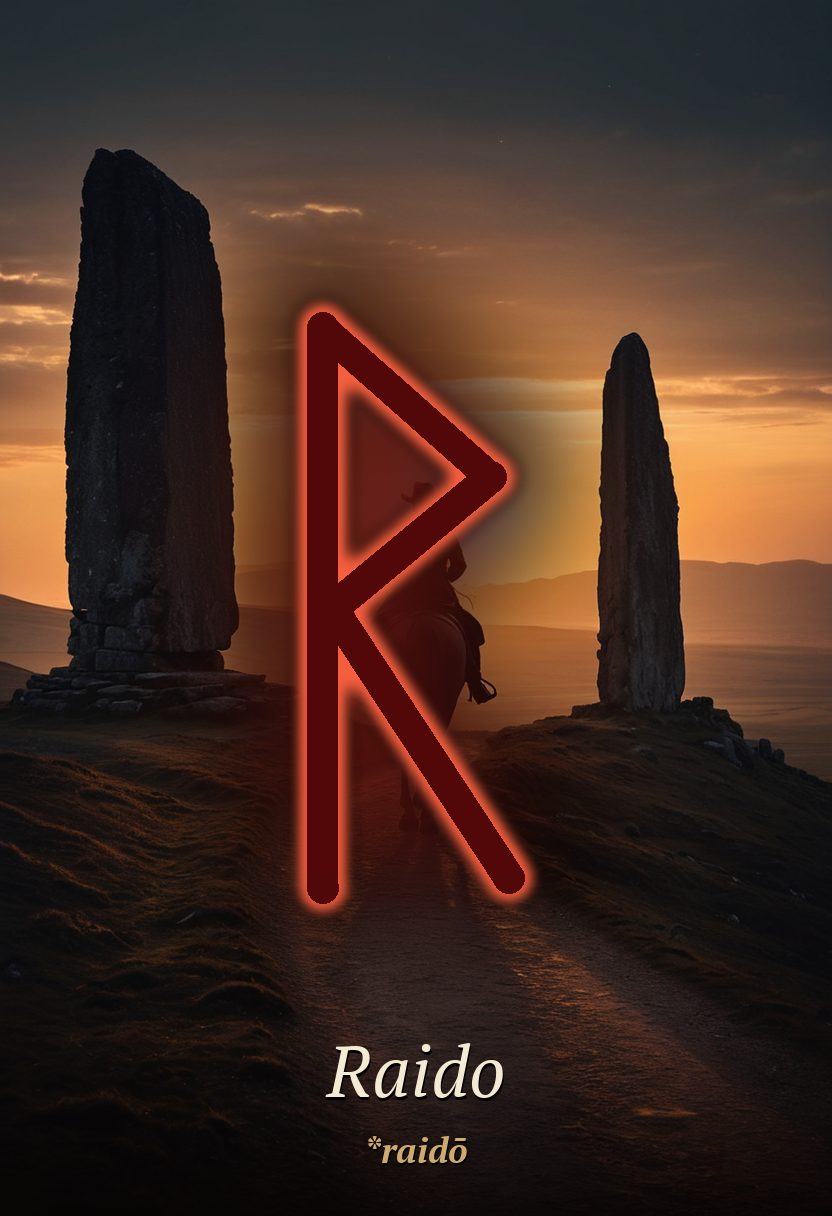
The cosmic law of right and the archetypal order of the multiverse — manifested in the sun's daily course, in the cycles of nature and of humankind. It is the mystery of divine law and the “way back to right,” traveled to restore the primal order; at the same time it is a symbol of organized religion (Ásatrú) as a fusion of faith, magic, and law. Raido is the true order of the initiate's wandering through the Nine Worlds of Yggdrasil, good counsel and judgment according to right, and also the ritual and ceremonial rhythm by which one merges with personal and cosmic harmony. And it is spiral development — eternal circles that always ascend toward a goal-point, and upon reaching it do not end but are transformed into a new beginning.
Divination. Paxson: the rune of the road and of movement — a trip, journey, or message, negotiations; change, entering a new situation, something new from outside, or a movement that brings order to chaos. Also counsel/guidance, following a plan, personal responsibility, and the “right way.”
Paxson does not single out a reversed meaning; in its “opposite sense” — a change of direction. Paired with Ansuz — misleading, ambiguous messages or dealings.
Weave this rune into a bind rune →
Historical meaning of the name: riding, road, journey.
The esoteric layer is a 20th–21st-c. reconstruction (Edred Thorsson = Stephen Flowers et al.). Not ancient and not proven magic; the rune names are not recorded in the inscriptions themselves. “Reversed” (merkstave) meanings are a late divinatory convention (popularized by R. Blum, 1982, after the Tarot model); symmetrical runes have no reversed form.
Sources: Esoteric core and magical workings — Thorsson, Futhark (1984); divination/shadow/practice — Diana Paxson, Taking Up the Runes (2005). Both are 20th–21st-century revival, not antiquity and not proof.

The rune of fire under human control — the flame of the torch and the smith's forge, directed by the will toward an intended result (in contrast to the raw elemental fire of Fehu). It is the mystery of rebirth through death and sacrifice: fire always transforms and regenerates. Kenaz is the ability and the will to create, the rune of the artist and craftsman, of the technical side of magic: the controlled energy of the psyche joins with the controlled energy of nature and gives birth to a crafted thing. It is the “human rune,” the vessel of knowledge together with skill. Here too belongs the mystery of the birth of a third out of the joining of two, and the rune of passion and sexual love as the root of all creation.
Divination. Paxson: the controlled fire of the torch/forge — illumination, knowledge (ken — “to know”), creativity and mastery, the transforming and purifying fire. With runes of fertility/craft — creative work; in mysticism — enlightenment; with runes of force — purification or uncontrolled passion.
Paxson gives no formal reversal; in a negative context (Gundarsson) — disintegration without reassembly; per Peterson — a misfortune that will worsen if left unattended. Fire out of control destroys rather than enlivens.
Weave this rune into a bind rune →
Historical meaning of the name: torch / pine-splint (or “sore/ulcer” — disputed).
The esoteric layer is a 20th–21st-c. reconstruction (Edred Thorsson = Stephen Flowers et al.). Not ancient and not proven magic; the rune names are not recorded in the inscriptions themselves. “Reversed” (merkstave) meanings are a late divinatory convention (popularized by R. Blum, 1982, after the Tarot model); symmetrical runes have no reversed form.
Sources: Esoteric core and magical workings — Thorsson, Futhark (1984); divination/shadow/practice — Diana Paxson, Taking Up the Runes (2005). Both are 20th–21st-century revival, not antiquity and not proof.

The rune of "god" — of that hidden, unconscious magical force that was present in Ginnungagap (the charged void) even before the worlds were made; the sacred mystery of two (or many) in one. It is the giver, the giving, the gift, and the one given to: "the subject, verb, and objects of the multiverse," and also part of the mystery of sacrifice as a gift of power by which gods and humans sustain the ecology of cosmic might. By the power of Gebo, people are bound by will toward a common result — this is the root force of runic orders and warband systems. Within it lie the secrets of joining two into a single creative force greater than their sum: the rune of sexual magic practiced for the attainment of wisdom.
Divination. Paxson: gift and exchange — generosity, reciprocity, union/partnership, receiving gifts or love, a wedding/mystical marriage, unity of intent; also contracts and agreements. A universal rune of luck (with Fehu — for prosperity, with Ingwaz — for fertility).
The rune is symmetrical — Paxson gives no reversal. The shadow: prodigality or stinginess, problems with flow; a gift can bind the recipient into dependency, and unwillingness on the giver's or taker's part spoils the exchange.
Weave this rune into a bind rune →
Historical meaning of the name: gift, present.
The esoteric layer is a 20th–21st-c. reconstruction (Edred Thorsson = Stephen Flowers et al.). Not ancient and not proven magic; the rune names are not recorded in the inscriptions themselves. “Reversed” (merkstave) meanings are a late divinatory convention (popularized by R. Blum, 1982, after the Tarot model); symmetrical runes have no reversed form.
Sources: Esoteric core and magical workings — Thorsson, "Futhark" (1984); divination/shadow/practice — Diana Paxson, "Taking Up the Runes" (2005). Both are 20th–21st-c. revival, not antiquity and not proof.

The root force of attraction that kindred beings (wights) from a common source feel for one another and that binds them into an organic whole — in humans this is embodied in clan and tribe. Ancient Germanic society was "clan-centric": a strong kin was the best defense both against outside invaders and against tyranny from within, and the honor of the kin safeguarded the freedom of the individual. Wunjo is the mystery of harmonious coexistence of different but kindred forces; when all members of the kin labor together in accord, fitted into their environment, true holiness is born. It is the energy that binds different fields of force into one, and so the vitki uses it to bind several runes into a single harmonious force toward a goal.
Divination. Paxson: joy, happiness, bliss — lends the surrounding runes a positive meaning; success in love and in working together, integration of the personality, good news, harmony, friendship. Drawn on the forehead, it lifts gloom.
Paxson states plainly: "in a negative position its dangers are stagnation, discord, and alienation." (Per Gundarsson, an excess of good fellowship threatens complacency and blindness to problems.)
Weave this rune into a bind rune →
Historical meaning of the name: joy, bliss.
The esoteric layer is a 20th–21st-c. reconstruction (Edred Thorsson = Stephen Flowers et al.). Not ancient and not proven magic; the rune names are not recorded in the inscriptions themselves. “Reversed” (merkstave) meanings are a late divinatory convention (popularized by R. Blum, 1982, after the Tarot model); symmetrical runes have no reversed form.
Sources: Esoteric core and magical workings — Thorsson, "Futhark" (1984); divination/shadow/practice — Diana Paxson, "Taking Up the Runes" (2005). Both are 20th–21st-c. revival, not antiquity and not proof.

The cosmic ice-egg, filled with crystallized magical force and the cosmic pattern: the hailstone is a symbol of the rimy "egg" with the seed of Ymir, the primal frost-giant born of the meeting of Muspellsheim's world-fire and Niflheim's world-ice. It is the full potential paradigm of the multiverse — a neutral force out of the dynamic unity of fire (energy) and ice (antimatter); the snowflake folds according to a sixfold sacred pattern. Hagalaz embodies eternal cosmic harmony and is linked to the sacred number nine (the nine worlds, Odin's nine nights on the tree, Heimdall's nine mothers). It is the "mother-rune": from the sixfold Hagalaz all runic forms can be derived; and it is a rune of protection and exorcism, since its whole harmony admits nothing disharmonious.
Divination. Paxson: hail, the "ice-grain" — a destructive event and a matrix of transformation. Often "beware, change is coming"; in Paxson's experience — something traumatic but not necessarily catastrophic; it carries the possibility of new beginnings and may shift from harmful to useful with time.
There is no formal reversal (the rune is symmetrical). The negative pole: per Aswynn — disruption, decline, destruction; per Sibley — a rune of disaster (if Jera is not nearby). Hel as death/cold is the obverse of life/rebirth.
Weave this rune into a bind rune →
Historical meaning of the name: hail.
The esoteric layer is a 20th–21st-c. reconstruction (Edred Thorsson = Stephen Flowers et al.). Not ancient and not proven magic; the rune names are not recorded in the inscriptions themselves. “Reversed” (merkstave) meanings are a late divinatory convention (popularized by R. Blum, 1982, after the Tarot model); symmetrical runes have no reversed form.
Sources: Esoteric core and magical workings — Thorsson, "Futhark" (1984); divination/shadow/practice — Diana Paxson, "Taking Up the Runes" (2005). Both are 20th–21st-c. revival, not antiquity and not proof.

The cosmic force of resistance through which the ruling Norns forge the "fate" (ørlög) of humans and the world. Naudiz is two-stranded: it is both need that presses on the heart and deliverance from it — the self-made "need-fire" kindled by friction and resistance. It is willed action with knowledge and wisdom, able to become a counterforce to the blind blows of doom: "Use your fate, do not strive against it" (von List). Naudiz is also "the coming-forth-into-manifestation," the moment when causality and law entered the world. Because of its sexual symbolism it became an instrument of Icelandic love magic and a strong rune of protection, especially spiritual.
Divination. Paxson: need/necessity — problems and obstacles pressing on the spirit, but also limitations that, rightly approached, become useful; a problem as an opportunity for growth, the necessity of action. Per Willis — delay, deprivation, the need for patience; the rune of the Norns and of fate.
Paxson does not formally single out a reversal; the negative aspect (Gundarsson): it can breed compulsiveness and obsession — an inner tension capable of driving toward greatness or of destroying.
Weave this rune into a bind rune →
Historical meaning of the name: need, constraint, hardship.
The esoteric layer is a 20th–21st-c. reconstruction (Edred Thorsson = Stephen Flowers et al.). Not ancient and not proven magic; the rune names are not recorded in the inscriptions themselves. “Reversed” (merkstave) meanings are a late divinatory convention (popularized by R. Blum, 1982, after the Tarot model); symmetrical runes have no reversed form.
Sources: Esoteric core and magical workings — Thorsson, "Futhark" (1984); divination/shadow/practice — Diana Paxson, "Taking Up the Runes" (2005). Both are 20th–21st-c. revival, not antiquity and not proof.

The antipole of Fehu: the world-ice flowing out of Niflheim. Isa is not matter, but rather a concept of "antimatter" which, joined with the energy of Muspellsheim, gives birth to what we call matter (Midgard); akin to the prima materia of other philosophies, symbolized by a "black hole." It is the force of attraction, of gravity, inertia, and entropy in the multiverse — immobility and the absence of vibration. At the same time, Isa is a symbol of the individual ego: the centering, concentrating force that holds the "I" together through the stressful trials of initiation and serves as a bridge between worlds.
Divination. Paxson: ISA ("ice") — a matter "frozen," stalled, or losing momentum, but which may later "thaw"; less often frozen irreversibly. Coldness between people, emotional rigidity, a pause — or, on the positive side, a need for rest, concentration, and inner stillness.
The rune is symmetrical — there is no reversal; the shadow (excess): dullness, numbness, sterility, paralyzing fear, insensitivity; the icy prison of an "I" that refuses to interact with the world. The force is brittle: overstrained, it "shatters into shards" — beware the energy released.
Weave this rune into a bind rune →
Historical meaning of the name: ice.
The esoteric layer is a 20th–21st-c. reconstruction (Edred Thorsson = Stephen Flowers et al.). Not ancient and not proven magic; the rune names are not recorded in the inscriptions themselves. “Reversed” (merkstave) meanings are a late divinatory convention (popularized by R. Blum, 1982, after the Tarot model); symmetrical runes have no reversed form.
Sources: Esoteric core and magical workings — Thorsson, "Futhark" (1984); divination/shadow/practice — Diana Paxson, "Taking Up the Runes" (2005). Both are 20th–21st-c. revival, not antiquity and not proof.

The cyclical pattern of the universe by the formula "arising — becoming — fading — new arising." Jera is one of the two "central runes" of the Futhark, setting the cyclical nature of the ever-becoming horizontal plane, the mystery of the omnipresent circle. It is the mystery of the twelvefold annual solar cycle: Raido is the daily path of the sun, Jera the yearly, Sowilo the sun itself. Jera is the reward for honest, right, and nature-conforming past action: not a moral but a natural law — the fruit of what was rightly sown under "luck" (hamingja). The cosmic aspect of fertility points to the god Freyr, invoked "til árs ok friðar" — for a good harvest and peace.
Divination. Paxson: JERA ("year/harvest") is almost always favorable — the season of reaping, reward for prior labor, the prosperity of the community, a good year; on the spiritual level — a need for movement and balance, acceptance of the natural cycle. It acts gently and gradually.
The rune is symmetrical — there is no reversal; the obverse: a bad sowing yields a bad fruit — "as you sow, so shall you reap," the evil of the turning wheel returns to the guilty. Beware: hastening growth nurtures the weeds along with the harvest.
Weave this rune into a bind rune →
Historical meaning of the name: (good) year, harvest.
The esoteric layer is a 20th–21st-c. reconstruction (Edred Thorsson = Stephen Flowers et al.). Not ancient and not proven magic; the rune names are not recorded in the inscriptions themselves. “Reversed” (merkstave) meanings are a late divinatory convention (popularized by R. Blum, 1982, after the Tarot model); symmetrical runes have no reversed form.
Sources: Esoteric core and magical workings — Thorsson, "Futhark" (1984); divination/shadow/practice — Diana Paxson, "Taking Up the Runes" (2005). Both are 20th–21st-c. revival, not antiquity and not proof.

Thorsson presents this as the vertical axis of the world — the central trunk of Yggdrasil, the world tree, which (on his reading) was specifically a yew (an evergreen conifer) rather than an ash, as is often assumed. "Yggdrasil" is taken to mean "the steed of Yggr (Odin)" or "the yew pillar": this is the shamanic rite of the Havamal by which the erilaz journeys to Hel and through all Nine Worlds for wisdom, along the vertical axis joining sky, earth, and underworld. Eihwaz is said to carry the mystery of life and death, mystically uniting them; the yew is poisonous and, with special preparation, a powerful hallucinogen — which the author treats as significant for the shamanic character of initiation. The long-lived evergreen tree is read as a symbol of unceasing life, endurance, and powerful protection: "Before yews no evil magic can stand."
Divination. Paxson: EIHWAZ (yew, the axis of Yggdrasil) — the rune of paradox and the joining of opposites; most often, in Paxson's experience, it signifies "making connections." It may point to spiritual ascent, a passage from one state to another, or that an outwardly bad situation will turn out for the better.
The rune is symmetrical — Paxson gives no separate reversal; the heavy pole is inherent in the rune's nature: the yew is the tree of life AND death, its poison kills or opens initiation; the axis of passage is a dangerous liminality (like Odin, who hung between earth and sky).
Weave this rune into a bind rune →
Historical meaning of the name: yew (tree).
The esoteric layer is a 20th–21st-c. reconstruction (Edred Thorsson = Stephen Flowers et al.). Not ancient and not proven magic; the rune names are not recorded in the inscriptions themselves. “Reversed” (merkstave) meanings are a late divinatory convention (popularized by R. Blum, 1982, after the Tarot model); symmetrical runes have no reversed form.
Sources: Esoteric core and magical workings — Thorsson, "Futhark" (1984); divination/shadow/practice — Diana Paxson, "Taking Up the Runes" (2005). Both are 20th–21st-century revival, not antiquity and not proof.

On Thorsson's reading, the rune of Ørlög — the "primal layers" of past deeds, those laws of cause and effect by which gods and humans are governed (a concept akin to the Sanskrit karma, opposed to Christian predestination). It is presented as the rune of the Norns (Urðr, Verðandi, Skuld) — of time and becoming, through which a deed is received and returned to the world in nearly unchanged form. Here too is the mystery of divination and synchronicity: gazing into Ørlög, the völva is said to perceive the power of Skuld, that which is yet to become. Perthro is framed as the great pattern of cosmic becoming, the paradigm by which the resistance of forces is organically balanced: constant change that always remains itself.
Divination. Paxson: PERTHRO (the cup for the lot, the rune of fate and chance) — to consider the working of fate/chance: either set forces are playing themselves out, or the unexpected will intervene; psychologically — to deal with uncertainty, to take a risk, or to "relax and play." Per Willis/Aswynn — the revealing of the hidden, unexpected good fortune.
Paxson does not single out a reversal/shadow directly (the meaning is fundamentally ambivalent, "not finally settled"). The reverse facet: knowledge one is not meant to have (or not yet); fate from birth (the limits of heredity/environment); a risk with an outcome that is "both good and ill."
Weave this rune into a bind rune →
Historical meaning of the name: not established (a dark rune — meaning genuinely disputed).
The esoteric layer is a 20th–21st-c. reconstruction (Edred Thorsson = Stephen Flowers et al.). Not ancient and not proven magic; the rune names are not recorded in the inscriptions themselves. “Reversed” (merkstave) meanings are a late divinatory convention (popularized by R. Blum, 1982, after the Tarot model); symmetrical runes have no reversed form.
Sources: Esoteric core and magical workings — Thorsson, "Futhark" (1984); divination/shadow/practice — Diana Paxson, "Taking Up the Runes" (2005). Both are 20th–21st-century revival, not antiquity and not proof.

Thorsson presents this as the symbolically most complex rune of the Futhark: its core is protection (Proto-Germanic algiz), and its form is derived from the "splayed hand" — an ancient gesture of defense. The Valkyries are associated with it — protective, strength-giving beings in cloaks of swan feathers, through whom Odin speaks to chosen heroes. It is read as the rune of the bond between gods and humans, the force that draws consciousness toward the world of the Æsir; it is also Bifröst, the rainbow bridge between Asgard, Midgard, and Hel, the "path of branches and roots" as distinct from the straight path of the trunk. Algiz is said to strengthen the hamingja (magical power and "luck") and the life-force striving upward, toward the Æsir.
Divination. Paxson (who calls the rune ELHAZ, "elk"): its appearance in a spread almost certainly means protection of the querent — possibly through turning to natural forces or to suppressed sides of the personality. Per Willis — a beneficial new influence, the voluntary sacrifice of the lesser for the greater; the querent will be protected, or at least forewarned.
Paxson: ELHAZ is double-edged, dangerous for the unprepared (Thorsson): the forces it connects you with must be identified with the self, not "grabbed" — as the sedge-elhaz cuts the one who clenches it. Its inverted form coincides with the peace sign and is easily confused with it.
Weave this rune into a bind rune →
Historical meaning of the name: elk / "protection" / sedge (disputed).
The esoteric layer is a 20th–21st-c. reconstruction (Edred Thorsson = Stephen Flowers et al.). Not ancient and not proven magic; the rune names are not recorded in the inscriptions themselves. “Reversed” (merkstave) meanings are a late divinatory convention (popularized by R. Blum, 1982, after the Tarot model); symmetrical runes have no reversed form.
Sources: Esoteric core and magical workings — Thorsson, "Futhark" (1984); divination/shadow/practice — Diana Paxson, "Taking Up the Runes" (2005). Both are 20th–21st-century revival, not antiquity and not proof.

Thorsson presents this as the archetypal sun and its light, expressed as the solar wheel (hvel) — the center of the ancient Hyperborean Bronze Age sun cult; in the Northern tradition the mystery of the sun is held to be feminine (Sól — the phenomenon, Sunna — its spiritual essence). Sowilo is framed as the magical will acting throughout the universe, the counter-force to cosmic ice; within the human being it is said to be expressed through the "spiritual wheels," hvel (kindred to the Sanskrit cakra). It is read as the highest spiritual force that leads the völva along the paths of Yggdrasil — at once the goal and the active willed path toward it, a dynamic link of sky and earth. It later became the "rune of victory," said to bring success when rightly applied (though the true sigrún of the ancients was the rune of Týr).
Divination. Paxson: SOWILO — illumination, clarification, the appearance of a guiding principle, movement after stagnation; a beacon of hope for those who strive; power, vital energy, success, luck, honor, achievement, the light of truth and of enlightened consciousness.
The rune is symmetrical — Paxson gives no reversal; the shadow as "excess of power": willfulness, arrogance, cruelty, isolation (the starkest example being the Nazis' appropriation of the rune as the SS symbol). Paired with Isa — the will is blocked.
Weave this rune into a bind rune →
Historical meaning of the name: sun.
The esoteric layer is a 20th–21st-c. reconstruction (Edred Thorsson = Stephen Flowers et al.). Not ancient and not proven magic; the rune names are not recorded in the inscriptions themselves. “Reversed” (merkstave) meanings are a late divinatory convention (popularized by R. Blum, 1982, after the Tarot model); symmetrical runes have no reversed form.
Sources: Esoteric core and magical workings — Thorsson, "Futhark" (1984); divination/shadow/practice — Diana Paxson, "Taking Up the Runes" (2005). Both are 20th–21st-century revival, not antiquity and not proof.

Thorsson presents this as the rune of the power of the god Áss-Týr — the god of law and justice, presiding over the thing (the folk-assembly); it is held to be a force of passive regulation, the one closest to the transcendent. Its central myth is sacrifice: Týr places his hand (his "active faculties") into the jaws of the wolf Fenrir, saving the Æsir, and so Tiwaz is the rune of self-sacrifice, of kings and leaders. It carries a threefold mystery: justice, war, and the world-pillar; the name is held to be an exact cognate of the Sanskrit Dyaus, the Greek Zeus, the Latin Ju-piter. War was conceived as a "judgment by arms" (vápnadómr), in which the victor is the one with more numinous power accumulated through honorable deeds. As the world-pillar (Irminsul, axis mundi) Tiwaz is said to divide sky and earth, upholding order; it is framed as the rune of spiritual discipline and faith by divine law.
Divination. Paxson: TIWAZ — a legal matter or a situation where one must fight for one's rights and seek justice; to hold to duty and serve a higher truth, if need be through self-sacrifice. It grants moral strength and the will to victory, resolve, and the possibility of conflict.
Paxson gives no formal reversal, but cites Gundarsson: negatively — rigidity, prejudice, loss of perspective. A caution: Týr is the god of absolute justice; calling on him, you will get justice, not necessarily victory for yourself in particular.
Weave this rune into a bind rune →
Historical meaning of the name: the god Tiwaz / Týr.
The esoteric layer is a 20th–21st-c. reconstruction (Edred Thorsson = Stephen Flowers et al.). Not ancient and not proven magic; the rune names are not recorded in the inscriptions themselves. “Reversed” (merkstave) meanings are a late divinatory convention (popularized by R. Blum, 1982, after the Tarot model); symmetrical runes have no reversed form.
Sources: Esoteric core and magical workings — Thorsson, "Futhark" (1984); divination/shadow/practice — Diana Paxson, "Taking Up the Runes" (2005). Both are 20th–21st-century revival, not antiquity and not proof.

Thorsson presents this as the rune of the Great Mother: on the cosmological plane — the mother of all that is manifest, the mystery of cosmic and human birth and rebirth. Berkanan is said to govern the four pivotal rites of passage — birth, coming of age, marriage, and death — and to carry the dark side of the "Terrible Mother," power over death (in myth — Hel; in Tacitus — the earth goddess Nerthus). It is framed as the vessel of all that is becoming, the unity of the cycle birth–life–death–rebirth through the "mystery of the moment" — that "unit of evolution" out of which becoming is built, where each instant is unique yet all are held by a single pattern. Berkanan is read as the passive receiver and the preserving, sheltering force that conceals and protects; it is said to govern all sheltering enclosures — caves, beds, initiatory "earth-houses."
Divination. Paxson: BERKANO — the rune of significant transitions: birth and becoming, rootedness, the feminine principle; "bringing into being," the first protection for a child at birth. Useful in women's fertility magic and women's mysteries; it conceals the working of other runes until the time of their manifestation — the rune of hidden transformation and growth.
Paxson gives no reversal/negative for BERKANO — it is presented only positively (birth, healing, nurture, protection). By implication the shadow is stagnation/blocked growth and the need to store up energy (Paxson mentions only "the need to conserve energy and take shelter").
Weave this rune into a bind rune →
Historical meaning of the name: birch (birch branch).
The esoteric layer is a 20th–21st-c. reconstruction (Edred Thorsson = Stephen Flowers et al.). Not ancient and not proven magic; the rune names are not recorded in the inscriptions themselves. “Reversed” (merkstave) meanings are a late divinatory convention (popularized by R. Blum, 1982, after the Tarot model); symmetrical runes have no reversed form.
Sources: Esoteric core and magical workings — Thorsson, "Futhark" (1984); divination/shadow/practice — Diana Paxson, "Taking Up the Runes" (2005). Both are 20th–21st-century revival, not antiquity and not proof.

The power of the divine twins — two principles mythically manifested as horses (Hengist and Horsa; the Vedic Ashvins — "the two horses"), as authors of the revival read it. This is held to be a rune of harmonious duality: two kindred but differently directed forces working in concert toward one goal (human/horse, body/soul, person/fylgja). Ehwaz is framed as the "chariot" of the journey between the worlds of Yggdrasil: the vitki is said to ride literally on its power across realities — the rune of Sleipnir, Odin's eight-legged steed. It is claimed to carry trust and loyalty — the spiritual bond a rider forms with a horse. It is also taken as a symbol of the ideal union of man and woman, the mystery of lawful marriage.
Divination. Paxson: EHWAZ — change and movement: a journey or development (spiritual or physical), a growth of possibilities through cooperation with another; sometimes a need to change the situation by changing one's own attitude. Associated with union, loyalty, teamwork "in harness" — a dynamic harmony with another.
Paxson gives no formal reversal, but cites Aswynn: negatively — loss or rupture of a relationship.
Weave this rune into a bind rune →
Historical meaning of the name: horse, steed.
The esoteric layer is a 20th–21st-c. reconstruction (Edred Thorsson = Stephen Flowers et al.). Not ancient and not proven magic; the rune names are not recorded in the inscriptions themselves. “Reversed” (merkstave) meanings are a late divinatory convention (popularized by R. Blum, 1982, after the Tarot model); symmetrical runes have no reversed form.
Sources: Esoteric core and magical workings — Thorsson, "Futhark" (1984); divination/shadow/practice — Diana Paxson, "Taking Up the Runes" (2005). Both are 20th–21st-c. revival, not antiquity and not proof.

The mystery, as revival authors claim, of the divine (archetypal) structure in each human being and in humanity as a whole — a structure said to be bestowed by Heimdall as the progenitor of humans ("Rígsþula"). The M-rune is read as a symbol of Heimdall as the genetic link between gods and humans: it is taken to define the human as a descendant of the gods and to describe the runic structure within the soul. It is held to be the power of the human mind, of rationality, memory, and tradition. Mannaz is framed as the rune of the "perfected human," the initiate; the archetype of the androgyne, carrying the mystery of androgyny in the psyche. It is also said to stand behind the establishing of blood-brotherhood.
Divination. Paxson: MANNAZ — the positive or negative sides of the human; it raises questions of identity and purpose — what it means to be human, how to realize one's potential, what one's role in society is. In a spiritual question — to turn to the collective unconscious and ancestral memory for creative solutions.
Paxson (via Aswynn): reversed it may mean an enemy/adversary. The rune's danger (Gundarsson) — pride and the thought that one is separate from humanity; in Peterson — human weakness, unreliability, mistrust.
Weave this rune into a bind rune →
Historical meaning of the name: human, mankind.
The esoteric layer is a 20th–21st-c. reconstruction (Edred Thorsson = Stephen Flowers et al.). Not ancient and not proven magic; the rune names are not recorded in the inscriptions themselves. “Reversed” (merkstave) meanings are a late divinatory convention (popularized by R. Blum, 1982, after the Tarot model); symmetrical runes have no reversed form.
Sources: Esoteric core and magical workings — Thorsson, "Futhark" (1984); divination/shadow/practice — Diana Paxson, "Taking Up the Runes" (2005). Both are 20th–21st-c. revival, not antiquity and not proof.

Held to be the basic life-energy of the multiverse and the secret source of all organic life; also the "law" (ON log) of life — the layers of past cosmic and human action governing the future development of forms, as the revival reads it. The L-rune is claimed to be the primal waters of Niflheim, holding the latent, formless potential of life that must be hardened by ice and kindled by the fire of Muspellsheim to be embodied. It is framed as a potent rune of initiation — especially initiation into life (the rite of sprinkling with water, vatni ausa, and the doctrine of rebirth). Laguz is also said to govern the passage out of life (the crossing of the primal waters to the world of the dead). In the form laukaz ("leek") it is taken as a symbol of organic growth, phallic power, fertility, and herbal magic.
Divination. Paxson: LAGUZ — a woman or feminine influence, new life and creative power rising from the depths of the unconscious, or a need to become more flexible and move with the currents of life. Often — transitions, contact with the psychic/astral, the powers of conception and birth, a promise of sympathetic help — to "go with the flow."
Paxson gives no classic reversal; the shadow is water's ambivalence: an uncontrollable, unpredictable, dangerous element (in the Anglo-Saxon poem the sea is terrifying), stagnant and poisonous as against living running water.
Weave this rune into a bind rune →
Historical meaning of the name: water, moisture, lake.
The esoteric layer is a 20th–21st-c. reconstruction (Edred Thorsson = Stephen Flowers et al.). Not ancient and not proven magic; the rune names are not recorded in the inscriptions themselves. “Reversed” (merkstave) meanings are a late divinatory convention (popularized by R. Blum, 1982, after the Tarot model); symmetrical runes have no reversed form.
Sources: Esoteric core and magical workings — Thorsson, "Futhark" (1984); divination/shadow/practice — Diana Paxson, "Taking Up the Runes" (2005). Both are 20th–21st-c. revival, not antiquity and not proof.

The name of the ancient Germanic earth-god Ing, who — as the revival reads it — acts in a pair with the mother-goddess Nerthus (the peoples called themselves Ingaevones — "those of Ing"; later Freyr became Ing-Yngvi). In the cult of Ing-Nerthus the feminine is said to absorb the masculine so as to replenish its forces after giving fertility to the earth: the masculine is framed as a self-replenishing "cosmic food" of potential energy, held by the goddess through the winter and released in a rush in spring. The NG-rune is taken as a storehouse of potential energy that must pass through a period of ripening (gestation) to gather strength: any force, before its most powerful manifestation, is said to pass through such a sheltered ripening. The rune is held to contain one of the great mysteries of Norse sex-magic.
Divination. Paxson: INGWAZ — creative power (especially male), the passage to a new stage of the cycle, a completion leading to a new beginning, transformation, possibly sacrifice for a positive goal, fertility. Often — the successful completion of a project; kin to Fehu and Jera; a rune of sexuality and male energy when the force "gives" rather than only "takes."
The rune is symmetrical (a closed diamond), so there is no reversal; the shadow arises from the rune's nature: the sacrificial god gives his power to the earth and goes down into death/the barrow — the energy must pass through a hidden gestation, a potential that is "dormant"; the masculine and feminine must interact as equals, or the force is not realized.
Weave this rune into a bind rune →
Historical meaning of the name: god/hero Ing / Ingwiz.
The esoteric layer is a 20th–21st-c. reconstruction (Edred Thorsson = Stephen Flowers et al.). Not ancient and not proven magic; the rune names are not recorded in the inscriptions themselves. “Reversed” (merkstave) meanings are a late divinatory convention (popularized by R. Blum, 1982, after the Tarot model); symmetrical runes have no reversed form.
Sources: Esoteric core and magical workings — Thorsson, "Futhark" (1984); divination/shadow/practice — Diana Paxson, "Taking Up the Runes" (2005). Both are 20th–21st-c. revival, not antiquity and not proof.

The light of day, perceived in the moments of sunrise and sunset, dawn and dusk — claimed by the revival to be the rune of full awakening (its mystery is read in the praise-prayer of Sigrdrífa, awakened by Sigurd). The D-rune is taken to be the ritual hearth-fire and the mystical light seen by the vitki in magical operations. Dagaz is framed as a synthesis of the powers of day and night through dawn and dusk, a rune of polarity and the "paradox of Odin," said to be the central mystery of the Odinic cult. It is held to be that "mystical moment" found in the whirl of polar concepts: through a secret "alchemy" two extremes become one — dark and light, pleasure and pain, life and death, body and soul, matter and energy are synthesized beyond their apparent opposition. Before dagaz, language is said to fail.
Divination. Paxson: DAGAZ — an almost entirely positive rune: good is coming, the "light at the end of the tunnel," the arrival of spring. Growth and increase in any sphere (often slow progress with a dramatic outcome), a turning point, dawn/sunset, awakening, hope. The counsel — to set oneself optimistically and persevere.
The rune is symmetrical (a "butterfly"/infinity sign), so there is no reversal; the shadow comes from its liminality (Aswynn): a cataclysmic reversal, when energy, having reached saturation, flips into its opposite; the risk of self-deception in "spiritual awakening."
Weave this rune into a bind rune →
Historical meaning of the name: day.
The esoteric layer is a 20th–21st-c. reconstruction (Edred Thorsson = Stephen Flowers et al.). Not ancient and not proven magic; the rune names are not recorded in the inscriptions themselves. “Reversed” (merkstave) meanings are a late divinatory convention (popularized by R. Blum, 1982, after the Tarot model); symmetrical runes have no reversed form.
Sources: Esoteric core and magical workings — Thorsson, "Futhark" (1984); divination/shadow/practice — Diana Paxson, "Taking Up the Runes" (2005). Both are 20th–21st-c. revival, not antiquity and not proof.

Claimed by the revival to be the mystery of the kindred's enclosure-stronghold, which marks out its sacred boundary and guards it against unclean intruders — said to be the essence of the cosmic notion of Midgard, the "enclosure in the middle." The O-rune is read as a sign of the innate qualities that come from descent from a particular kindred: spiritual in nature, traced back to a divine ancestor and to the past deeds of forebears. It is taken to be the mystery of the fylgja as a spiritual source of magical power, accumulating from the valiant deeds of past generations as runic imprints in the "genetic codes" of descendants (a mighty rune of Odin; its form is read as a monogram of Odin). What is inherited by the whole kindred in material and spiritual terms is held to be as immovable as land, not alienable from the kindred. It is framed as a rune of material wealth and of the wise, just stewardship of land by tradition and law. (As with this rune's modern folkish use, the framing of "descent" and "kindred" here carries an appropriation history worth flagging.)
Divination. Paxson: OTHALA — family (physical or spiritual) and one's place in the community; living conditions (home, housemates), ancestral property, land, inheritance, inherited traits, connection to the ancestral homeland, finding a group of one's own spirit. A rune of kinship and the "sacred enclosure."
Paxson directly names the "opposite, or perversion" of OTHALA: totalitarianism and slavery; here too the Nazi abuse of the rune in doctrines of "Folk" and "racial purity," the danger of exclusionary innangarth thinking against all that is foreign.
Weave this rune into a bind rune →
Historical meaning of the name: inheritance, ancestral holding, patrimony.
The esoteric layer is a 20th–21st-c. reconstruction (Edred Thorsson = Stephen Flowers et al.). Not ancient and not proven magic; the rune names are not recorded in the inscriptions themselves. “Reversed” (merkstave) meanings are a late divinatory convention (popularized by R. Blum, 1982, after the Tarot model); symmetrical runes have no reversed form.
Sources: Esoteric core and magical workings — Thorsson, "Futhark" (1984); divination/shadow/practice — Diana Paxson, "Taking Up the Runes" (2005). Both are 20th–21st-c. revival, not antiquity and not proof.