
Jera — (good) year, harvest
sound j · Proto-Germanic *jēra · rune 12 of 24
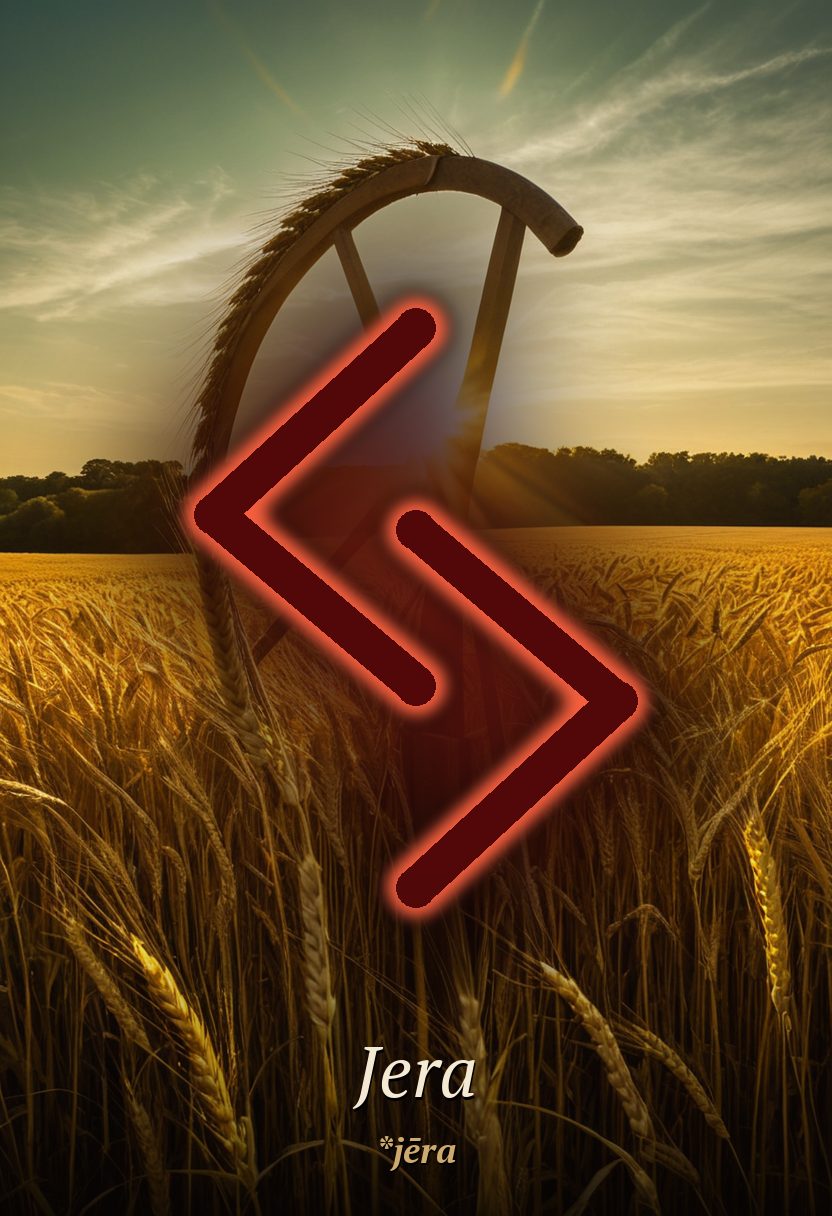
The cyclical pattern of the universe by the formula "arising — becoming — fading — new arising." Jera is one of the two "central runes" of the Futhark, setting the cyclical nature of the ever-becoming horizontal plane, the mystery of the omnipresent circle. It is the mystery of the twelvefold annual solar cycle: Raido is the daily path of the sun, Jera the yearly, Sowilo the sun itself. Jera is the reward for honest, right, and nature-conforming past action: not a moral but a natural law — the fruit of what was rightly sown under "luck" (hamingja).
Core meaningmodern reconstruction, 20th c.
The cyclical pattern of the universe by the formula "arising — becoming — fading — new arising." Jera is one of the two "central runes" of the Futhark, setting the cyclical nature of the ever-becoming horizontal plane, the mystery of the omnipresent circle. It is the mystery of the twelvefold annual solar cycle: Raido is the daily path of the sun, Jera the yearly, Sowilo the sun itself. Jera is the reward for honest, right, and nature-conforming past action: not a moral but a natural law — the fruit of what was rightly sown under "luck" (hamingja). The cosmic aspect of fertility points to the god Freyr, invoked "til árs ok friðar" — for a good harvest and peace.
Jera in divinationmodern reconstruction, 20th c.
Paxson: JERA ("year/harvest") is almost always favorable — the season of reaping, reward for prior labor, the prosperity of the community, a good year; on the spiritual level — a need for movement and balance, acceptance of the natural cycle. It acts gently and gradually.
Draw this rune in a spread → free reading for your questionJera reversed (merkstave)modern reconstruction, 20th c.
The rune is symmetrical — there is no reversal; the obverse: a bad sowing yields a bad fruit — "as you sow, so shall you reap," the evil of the turning wheel returns to the guilty. Beware: hastening growth nurtures the weeds along with the harvest.
Jera in rune magicmodern reconstruction, 20th c.
- fertility, creativity
- peace, harmony
- enlightenment
- awareness of the cyclical nature of the multiverse
- bringing designs into material manifestation
- galdr: "je-ra-je-ra-je-ra… jjjeeerrraaa… yu-ya-i-e-o…"
- Paxson (practice): garden magic — sing JERA (and Fehu/Uruz/Ingwaz) over the seeds, trace it on tablets bearing the plant's name; offer the garden as a sanctuary to the local land-spirits.
The historical layerhistorical fact
The reconstructed Proto-Germanic name *jēra means “(good) year, harvest” — that much comes from the rune poems and comparative linguistics. The esoteric readings above are a 20th–21st-century reconstruction, not an attested ancient practice — see the Elder Futhark reference for what is actually historical.
Sources
Esoteric core and magical workings — Thorsson, "Futhark" (1984); divination/shadow/practice — Diana Paxson, "Taking Up the Runes" (2005). Both are 20th–21st-c. revival, not antiquity and not proof.
Questions about Jera
What does the Jera rune mean?
Jera (*jēra) — (good) year, harvest. The cyclical pattern of the universe by the formula "arising — becoming — fading — new arising." Jera is one of the two "central runes" of the Futhark, setting the cyclical nature of the ever-becoming horizontal plane, the mystery of the omnipresent circle. It is the mystery of the twelvefold annual solar cycle: Raido is the daily path of the sun, Jera the yearly, Sowilo the sun itself.
What does Jera reversed mean?
The rune is symmetrical — there is no reversal; the obverse: a bad sowing yields a bad fruit — "as you sow, so shall you reap," the evil of the turning wheel returns to the guilty. Beware: hastening growth nurtures the weeds along with the harvest.
How do you pronounce Jera?
The sound is “j”; the reconstructed Proto-Germanic name is *jēra.