
Berkano — birch (birch branch)
sound b · Proto-Germanic *berkanan · rune 18 of 24 · also spelled Berkana
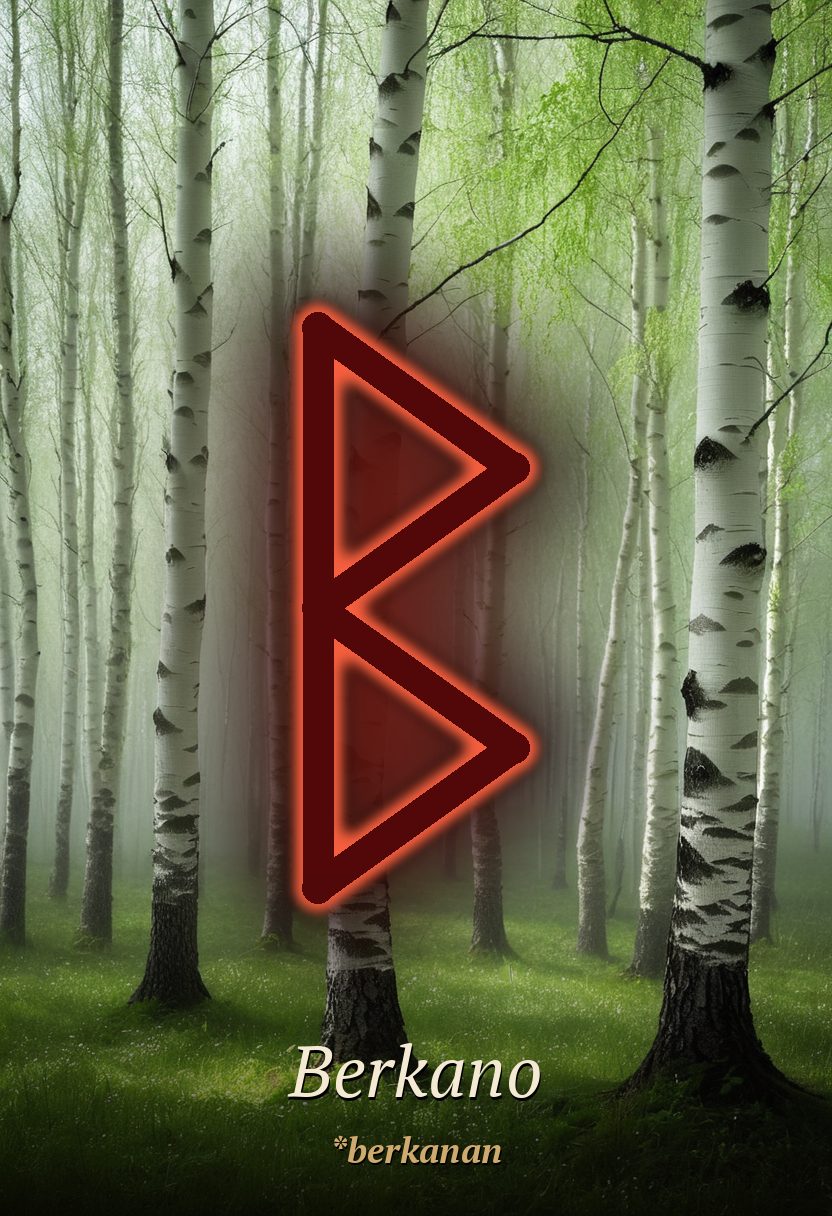
Thorsson presents this as the rune of the Great Mother: on the cosmological plane — the mother of all that is manifest, the mystery of cosmic and human birth and rebirth. Berkanan is said to govern the four pivotal rites of passage — birth, coming of age, marriage, and death — and to carry the dark side of the "Terrible Mother," power over death (in myth — Hel; in Tacitus — the earth goddess Nerthus). It is framed as the vessel of all that is becoming, the unity of the cycle birth–life–death–rebirth through the "mystery of the moment" — that "unit of evolution" out of which becoming is built, where each instant is unique yet all are held by a single pattern.
Core meaningmodern reconstruction, 20th c.
Thorsson presents this as the rune of the Great Mother: on the cosmological plane — the mother of all that is manifest, the mystery of cosmic and human birth and rebirth. Berkanan is said to govern the four pivotal rites of passage — birth, coming of age, marriage, and death — and to carry the dark side of the "Terrible Mother," power over death (in myth — Hel; in Tacitus — the earth goddess Nerthus). It is framed as the vessel of all that is becoming, the unity of the cycle birth–life–death–rebirth through the "mystery of the moment" — that "unit of evolution" out of which becoming is built, where each instant is unique yet all are held by a single pattern. Berkanan is read as the passive receiver and the preserving, sheltering force that conceals and protects; it is said to govern all sheltering enclosures — caves, beds, initiatory "earth-houses."
Berkano in divinationmodern reconstruction, 20th c.
Paxson: BERKANO — the rune of significant transitions: birth and becoming, rootedness, the feminine principle; "bringing into being," the first protection for a child at birth. Useful in women's fertility magic and women's mysteries; it conceals the working of other runes until the time of their manifestation — the rune of hidden transformation and growth.
Draw this rune in a spread → free reading for your questionBerkano reversed (merkstave)modern reconstruction, 20th c.
Paxson gives no reversal/negative for BERKANO — it is presented only positively (birth, healing, nurture, protection). By implication the shadow is stagnation/blocked growth and the need to store up energy (Paxson mentions only "the need to conserve energy and take shelter").
Berkano in rune magicmodern reconstruction, 20th c.
- rebirth in spirit
- strengthening the power of mystery and concealment
- workings of concealment and protection
- holding and binding other forces together
- bringing ideas to fruition in the creative process
- galdr: "berkanan-berkanan-berkanan… bu-ba-bi-be-bo… be-e-rr-rr…"
- Paxson (practice): in "The Tree of Tyr," a bundle of birch twigs passes around the circle, and each person strikes themselves with it several times — a birch blessing-purification ("the blows wake the blood… they sting with power").
The historical layerhistorical fact
The reconstructed Proto-Germanic name *berkanan means “birch (birch branch)” — that much comes from the rune poems and comparative linguistics. The esoteric readings above are a 20th–21st-century reconstruction, not an attested ancient practice — see the Elder Futhark reference for what is actually historical.
Sources
Esoteric core and magical workings — Thorsson, "Futhark" (1984); divination/shadow/practice — Diana Paxson, "Taking Up the Runes" (2005). Both are 20th–21st-century revival, not antiquity and not proof.
Questions about Berkano
What does the Berkano rune mean?
Berkano (*berkanan) — birch (birch branch). Thorsson presents this as the rune of the Great Mother: on the cosmological plane — the mother of all that is manifest, the mystery of cosmic and human birth and rebirth. Berkanan is said to govern the four pivotal rites of passage — birth, coming of age, marriage, and death — and to carry the dark side of the "Terrible Mother," power over death (in myth — Hel; in Tacitus — the earth goddess Nerthus).
What does Berkano reversed mean?
Paxson gives no reversal/negative for BERKANO — it is presented only positively (birth, healing, nurture, protection). By implication the shadow is stagnation/blocked growth and the need to store up energy (Paxson mentions only "the need to conserve energy and take shelter").
How do you pronounce Berkano?
The sound is “b”; the reconstructed Proto-Germanic name is *berkanan.