
Sowilo — sun
sound s · Proto-Germanic *sōwilō · rune 16 of 24 · also spelled Sowulo
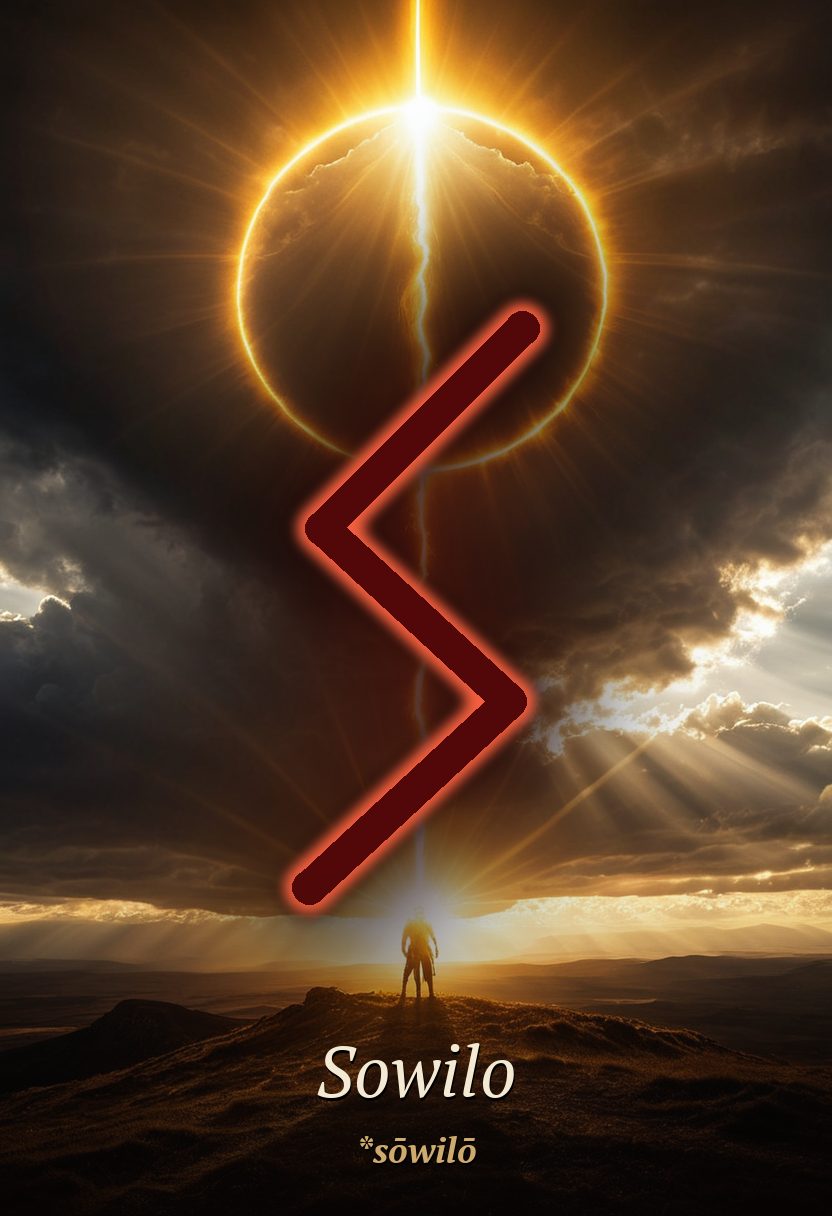
Thorsson presents this as the archetypal sun and its light, expressed as the solar wheel (hvel) — the center of the ancient Hyperborean Bronze Age sun cult; in the Northern tradition the mystery of the sun is held to be feminine (Sól — the phenomenon, Sunna — its spiritual essence). Sowilo is framed as the magical will acting throughout the universe, the counter-force to cosmic ice; within the human being it is said to be expressed through the "spiritual wheels," hvel (kindred to the Sanskrit cakra). It is read as the highest spiritual force that leads the völva along the paths of Yggdrasil — at once the goal and the active willed path toward it, a dynamic link of sky and earth.
Core meaningmodern reconstruction, 20th c.
Thorsson presents this as the archetypal sun and its light, expressed as the solar wheel (hvel) — the center of the ancient Hyperborean Bronze Age sun cult; in the Northern tradition the mystery of the sun is held to be feminine (Sól — the phenomenon, Sunna — its spiritual essence). Sowilo is framed as the magical will acting throughout the universe, the counter-force to cosmic ice; within the human being it is said to be expressed through the "spiritual wheels," hvel (kindred to the Sanskrit cakra). It is read as the highest spiritual force that leads the völva along the paths of Yggdrasil — at once the goal and the active willed path toward it, a dynamic link of sky and earth. It later became the "rune of victory," said to bring success when rightly applied (though the true sigrún of the ancients was the rune of Týr).
Sowilo in divinationmodern reconstruction, 20th c.
Paxson: SOWILO — illumination, clarification, the appearance of a guiding principle, movement after stagnation; a beacon of hope for those who strive; power, vital energy, success, luck, honor, achievement, the light of truth and of enlightened consciousness.
Draw this rune in a spread → free reading for your questionSowilo reversed (merkstave)modern reconstruction, 20th c.
The rune is symmetrical — Paxson gives no reversal; the shadow as "excess of power": willfulness, arrogance, cruelty, isolation (the starkest example being the Nazis' appropriation of the rune as the SS symbol). Paired with Isa — the will is blocked.
Sowilo in rune magicmodern reconstruction, 20th c.
- strengthening the psychic centers, the hvel
- the increase of spiritual will
- guidance along the paths, "enlightenment"
- victory and success through the power of individual will
- galdr: "sowilo-sowilo-sowilo… s-s-s-s… su-sa-si-se-so…"
- Paxson (practice): in the ritual "Safe on the Sun Road" touch the power of the sun by leaping over its symbol (from Bronze Age petroglyphs), then perform the self-blessing Sig-galdor, drawing SOWILO to each direction while turning sunwise.
The historical layerhistorical fact
The reconstructed Proto-Germanic name *sōwilō means “sun” — that much comes from the rune poems and comparative linguistics. The esoteric readings above are a 20th–21st-century reconstruction, not an attested ancient practice — see the Elder Futhark reference for what is actually historical.
Sources
Esoteric core and magical workings — Thorsson, "Futhark" (1984); divination/shadow/practice — Diana Paxson, "Taking Up the Runes" (2005). Both are 20th–21st-century revival, not antiquity and not proof.
Questions about Sowilo
What does the Sowilo rune mean?
Sowilo (*sōwilō) — sun. Thorsson presents this as the archetypal sun and its light, expressed as the solar wheel (hvel) — the center of the ancient Hyperborean Bronze Age sun cult; in the Northern tradition the mystery of the sun is held to be feminine (Sól — the phenomenon, Sunna — its spiritual essence). Sowilo is framed as the magical will acting throughout the universe, the counter-force to cosmic ice; within the human being it is said to be expressed through the "spiritual wheels," hvel (kindred to the Sanskrit cakra).
What does Sowilo reversed mean?
The rune is symmetrical — Paxson gives no reversal; the shadow as "excess of power": willfulness, arrogance, cruelty, isolation (the starkest example being the Nazis' appropriation of the rune as the SS symbol). Paired with Isa — the will is blocked.
How do you pronounce Sowilo?
The sound is “s”; the reconstructed Proto-Germanic name is *sōwilō.