
Perthro — not established (a dark rune — meaning genuinely disputed)
sound p · Proto-Germanic *perþrō · rune 14 of 24 · also spelled Pertho
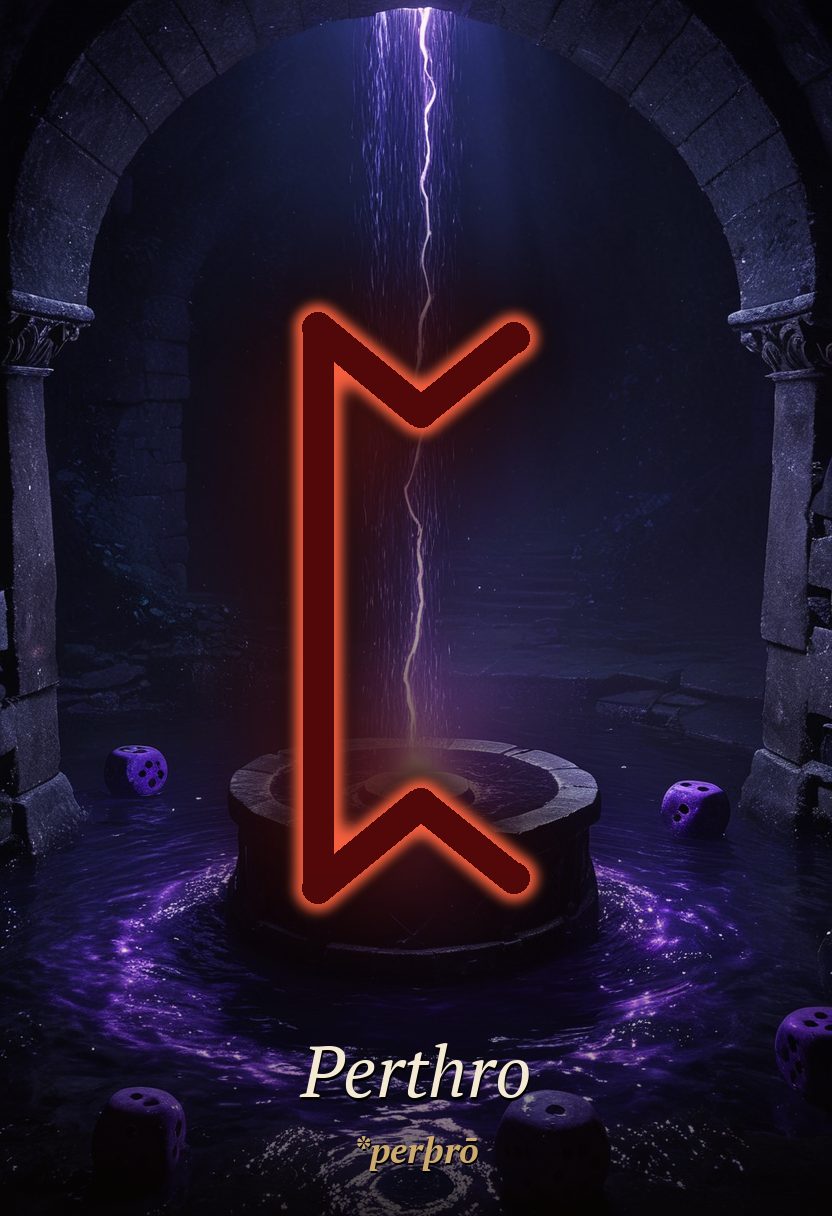
On Thorsson's reading, the rune of Ørlög — the "primal layers" of past deeds, those laws of cause and effect by which gods and humans are governed (a concept akin to the Sanskrit karma, opposed to Christian predestination). It is presented as the rune of the Norns (Urðr, Verðandi, Skuld) — of time and becoming, through which a deed is received and returned to the world in nearly unchanged form. Here too is the mystery of divination and synchronicity: gazing into Ørlög, the völva is said to perceive the power of Skuld, that which is yet to become.
Core meaningmodern reconstruction, 20th c.
On Thorsson's reading, the rune of Ørlög — the "primal layers" of past deeds, those laws of cause and effect by which gods and humans are governed (a concept akin to the Sanskrit karma, opposed to Christian predestination). It is presented as the rune of the Norns (Urðr, Verðandi, Skuld) — of time and becoming, through which a deed is received and returned to the world in nearly unchanged form. Here too is the mystery of divination and synchronicity: gazing into Ørlög, the völva is said to perceive the power of Skuld, that which is yet to become. Perthro is framed as the great pattern of cosmic becoming, the paradigm by which the resistance of forces is organically balanced: constant change that always remains itself.
Perthro in divinationmodern reconstruction, 20th c.
Paxson: PERTHRO (the cup for the lot, the rune of fate and chance) — to consider the working of fate/chance: either set forces are playing themselves out, or the unexpected will intervene; psychologically — to deal with uncertainty, to take a risk, or to "relax and play." Per Willis/Aswynn — the revealing of the hidden, unexpected good fortune.
Draw this rune in a spread → free reading for your questionPerthro reversed (merkstave)modern reconstruction, 20th c.
Paxson does not single out a reversal/shadow directly (the meaning is fundamentally ambivalent, "not finally settled"). The reverse facet: knowledge one is not meant to have (or not yet); fate from birth (the limits of heredity/environment); a risk with an outcome that is "both good and ill."
Perthro in rune magicmodern reconstruction, 20th c.
- perceiving one's own and the transpersonal Ørlög
- divination, reading fate
- placing runic forces into the stream of Nornic law
- unfolding ideas and events as a magical act
- galdr: "perthro-perthro-perthro… pu-pa-pi-pe-po… pe-e-rr-th-rr-o-o…"
- Paxson (practice): casting runes for a newborn — at the name-giving, honor the Dísir, set up an altar to the Mothers, and draw for the infant three runes for the wyrd of inheritance, three for the influence of environment, three for the luck of the future; playing dice / Hnefatafl — tuning the mind to chance and fate.
The historical layerhistorical fact
The reconstructed Proto-Germanic name *perþrō means “not established (a dark rune — meaning genuinely disputed)” — that much comes from the rune poems and comparative linguistics. The esoteric readings above are a 20th–21st-century reconstruction, not an attested ancient practice — see the Elder Futhark reference for what is actually historical.
Sources
Esoteric core and magical workings — Thorsson, "Futhark" (1984); divination/shadow/practice — Diana Paxson, "Taking Up the Runes" (2005). Both are 20th–21st-century revival, not antiquity and not proof.
Questions about Perthro
What does the Perthro rune mean?
Perthro (*perþrō) — not established (a dark rune — meaning genuinely disputed). On Thorsson's reading, the rune of Ørlög — the "primal layers" of past deeds, those laws of cause and effect by which gods and humans are governed (a concept akin to the Sanskrit karma, opposed to Christian predestination). It is presented as the rune of the Norns (Urðr, Verðandi, Skuld) — of time and becoming, through which a deed is received and returned to the world in nearly unchanged form.
What does Perthro reversed mean?
Paxson does not single out a reversal/shadow directly (the meaning is fundamentally ambivalent, "not finally settled"). The reverse facet: knowledge one is not meant to have (or not yet); fate from birth (the limits of heredity/environment); a risk with an outcome that is "both good and ill."
How do you pronounce Perthro?
The sound is “p”; the reconstructed Proto-Germanic name is *perþrō.